|
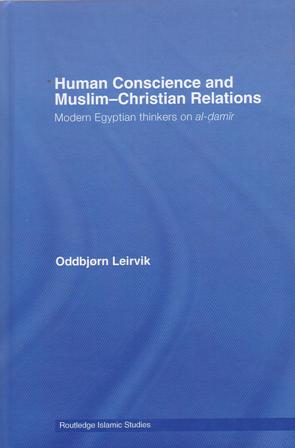
Oddbjørn Leirvik: Human Conscience and Christian-Muslim Relations: Modern Egyptian thinkers
London and New York: Routledge (Islamic Studies Series), 2006
310pp.
|
PART I Introduction:
I HORIZON
AND FOCUS
1.1 Interreligious
studies and theology in dialogue
1.2 Genesis, focus and organisation of the investigation
2
TERMS, CONCEPTS AND METHODS
2.1 Terms and concepts
* Conscience, and al-damīr * Modernity * Authenticity
2.2 Clues to current debates * Selfhood and otherness: the capitalised Other * Universalism and communitarianism 2.3 Methodological perspectives * Conceptual history and discourse analysis *
Intertextuality,
dialogical imagination and diapractice
PART II Christian
conscience and Islamic ethics
3 THE SELF AND THE OTHER IN CHRISTIAN AND EUROPEAN DISCOURSES OF CONSCIENCE 3.1 Some fundamental ambiguities
in the notion of conscience 3.2 Conscience
in Graeco-Roman literature, and in the New Testament
3.3
Conscience
in medieval scholasticism, and in Luther
3.4
Conscience
in Early Modernity
3.5 Critique
of conscience and globalisation of the concept in the 20th
century
3.6 Preliminary conclusion
4
ISLAMIC ETHICS – KNOWING WITH WHOM? 4.1
Bridging ‘conscience’ and ‘Islamic ethics’
4.2 Islamic ethics as a multi-layered
tradition
4.3 Qur’ānic ethics: exclusive
or dialogical?
4.4
Some notes
on ethics in Hadıth, fiqh
and classical theology
4.5
Philosophical ethics in Islam: universalist humanism?
4.6 Sūfī ethics and the synthesis of al-Ghazālī
4.7
Conscience, science and civilisation in European Christianity
and Islam 4.8
Preliminary conclusion
PART III Interlude: the semantics of damīr 5 CONSCIENCE IN ARABIC: THE SEMANTICS OF DAMĪR
5.1
‘Conscience’ in modern Arabic
5.2 Damīr in classical and medieval Arabic, and in medieval/early modern Arabic dictionaries * Damīr in Shıfiite, Sūfī and philosophical/secular usage * Damīr in grammar and logical theory *
Damīr in early dictionaries, Arab
and Western
5.3 Damīr as moral consciousness – since
when?
5.4 Damīr in biblical Arabic * Damīr in medieval and early modern Arabic Bible language *
Damīr in modern Arabic Bible editions
5.5 Other
words and constructs for ‘conscience’ in modern Arabic 5.6 Preliminary
conclusion
PART IV Al-damīr in modern Egyptian
Muslim authors 6 THE NOTIONS OF AL-DAMĪR AND WIJDĀN IN EGYPTIAN REFORMERS AND WRITERS
6.1 Introduction to Part IV 6.2 Damīr and the reception of French
thought and European philosophy in Egypt 6.3 Damīr
and wijdān among Egyptian
reformers, ca. 1900-1925
6.4
Literary reflections of damīr
in modern Egyptian essays and fiction, ca. 1950-1975
6.5 Preliminary conclusion
7 ‘ABBĀS MAHMŪD ETHICO-RELIGIOUS INTERNALISATION, HUMAN CONSCIENCE
AND ISLAMIC APOLOGETICS
7.1 Biographical and bibliographical introduction 7.2 Al-damīr
in al-‘Aqqād’s ‘spiritual portraits’
* The genius of Muhammad, and his upright conscience
* Between Muhammad and Christ: Mahatma Gandhi
* The genius of Christ, and his law of love and
conscience
* The genius of the Islamic philosopher-reformer
* Narrative and discursive approaches to al-damīr
7.3 Conscience, democracy
and Islamic authenticity
7.4 Revelation, reason and conscience in al-‘Aqqād’s qur’ānic philosophy
* Qur’ānic philosophy, new morality and male elitism
* Conscience under the guardianship of reason
* Conscience under the guardianship of reason * Conscience, Islamic mysticism and European existentialism * The role of conscience in al-‘Aqqād’s qur’ānic anthropology
* The role of conscience in al-‘Aqqād’s qur’ānic
anthropology 7.5 Preliminary conclusion and outlook
7.6 Al-‘Aqqād, internalisation
and authenticity
CONSCIENCE,
HUMAN AUTHENTICITY AND ISLAMIC DEMOCRACY
8.1
Biographical and bibliographical introduction
8.2 Secularism and European impulses * Modernist, secularist beginnings: ‘From here we start’ *
Conscience, new morality and civic ethics
8.3 Visions
of true humanity
8.4 Al-damīr in the history of religions: a continuous quest for human authenticity * Muhammad and Christ, together on the road * The human qualities of Muhammad *
Human conscience on its journey towards its destiny
8.5 Al-damīr and the Islamic heritage: narrative, thematic and mystical approaches * Narrative approaches to distinguished Muslim personalities * Thematic approach to the humanist message of the Qur'ān * Sūfı perspectives on human conscience
8.6 From human to Islamic authenticity? * From universalist liberalism to Islamic democracy *
The final call: Islam invites the human race to
accept Muhammad 8.7 Preliminary conclusion and
outlook
8.8 Excursus: Conscience and Islamic authenticity
in Sayyid Qutb
9 M. KĀMIL HUSAYN (1901-1977): CONSCIENCE
AS THE LAW OF INHIBITION AND THE VOICE OF GOD
9.1
Biographical and bibliographical introduction
9.2
The events of Good Friday as a drama of human conscience 9.3 Conscience
as a curb and the law of inhibition
9.4
The passive virtues of resistance, and the individual’s right
to say no 9.5
Conscience as the voice of God, and one’s rightly guided self
9.7 Preliminary conclusion and outlook
10.1
Modern Muslim identity in *
Islamic discourses
and universalist visions under 10.2 Christianity
and Islam in modern 10.3 Modern Coptic identity * The discourse of national unity: mere secularism, or Christian recognition of Islam? * Coptic conscience * The discourse of Coptic revival: national unity
challenged by the religious body?
10.4 Late modern identity discourses among Muslims, and the notion of Islamic authenticity
12 WRONGING THE SELF, WRONGING THE OTHER: CONSCIENCE
AND ETHICS IN MODERNITY
12.1 Conscience and the inward
turn forwards
12.2 The
Christian-Muslim quest for self-improvement: 12.3
Conscience, reason and emotion in the modern Self
12.4 Being
true to the Other – guided by
the Golden Rule, or by the ethics of closeness?
12.5
Wronging Oneself or wronging the Other?
12.6 Bad
conscience and
‘the reproaching soul’
13
CONSCIENCE IN INTERRELIGIOUS DIALOGUE: TELLING THE STORY OF ONESELF AS ANOTHER
13.1
The turn to the Other
13.2
Islam and the religously Other
13.3
Conscience = knowing oneself as another?
13.4
Telling the story of oneself as another – in diapractice 13.5
Conscience and community
14
KNOWING WITH GOD
|