HEART RATE VARIABILITY DURING RECOVERY FROM 30-MINUTE EXERCISE is greatest in the morning.
1Div of Arctic Chronobiology, Finnmark College, N-9509 Alta, Norway; 2College Biol Sciences and 3Chronobiology Center, University of Minnesota, USA.
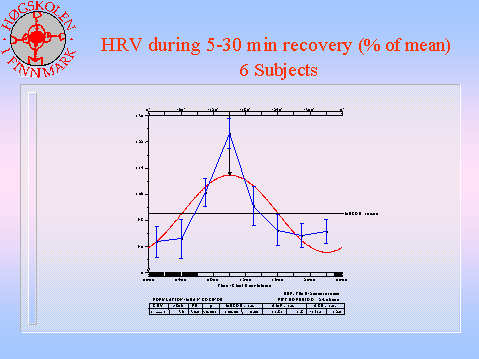
Aim: A decreased heart rate variability (HRV) has been connected to an increase in coronary heart disease (CHD). Exercise is used in medicine to put stress on the heart when looking for CHD. We tested to see if HRV during recovery after 30 min of exercise was influenced by the time of the exercise. Methods: Individual anaerobic threshold (AT) for 6 healthy males, ages 23-30y, was established. After 1h rest, subjects ran on a treadmill for 30min at a speed reaching the speed of AT within 5 minutes. Water was freely available. Inter-beat intervals (RR-time) of the heartbeats were recorded. After running, subjects immediately sat down for an hour. The resting-exercise-resting schedule was performed at 8 times of the day/night (01:00, 04:00, 07:00, 10:00, 13:00, 16:00, 19:00, & 22:00h) over 11 days. The trend for HR decrease during 5min to 60min after exercise (recovery) was removed and the standard deviation (SD) for the RR time-residuals for each 5min interval was calculated (SD=HRV). The individual and grouped HRV-values (using data as % of mean) were tested for rhythm by the least-squares fit of a 24h cosine and summarized by population mean cosinor. Rhythm characteristics derived include amplitude (A) and acrophase (Ø). Results: Grouped data revealed a significant 24h rhythm at 5min (p=0.017, A=18%, Ø=07:03h), 10min (p=0.015, A= 6%, Ø=09:29h), 30min (p=0.043, A=17%, Ø=12:38h), 5-15min (p<0.001, A=14%, Ø=08:35h) and 20-30min (p=0.011, A=12%, Ø=11:49h) into recovery. Conclusions: HRV during recovery over the first 30 min after exercise was greater between awakening and noon. The larger recovery HRV values in the morning could be an overcompensation response to the stress of exercise. The morning is the time when the incidence of myocardial infarction is at its peak. Individuals who are unable to make this response could possibly be at a higher risk for CHD.
| Skriv ut - | Sideoversikt - | Standardversjon |
| Oppdatert av Roy Hansnes 30.03.2007 |