TransPlant
The TransPlant project is part of the Norwegian Research Council UTFORSK programme which aims to strengthen links between higher education and international research collaborations. The UTFORSK programme promotes cooperation between institutes in Norway and in Brazil, China, India, Japan, Russia, and South Africa.
tansplantsites.jpg

The TansPlant project is a cooperation between the University of Bergen (EECRG), NINA, and the Meteorological Institute in Norway along with partners from the Royal Botanic Gardens at Kew (UK), Charles University (Czech Republic), and the University of Michigan (USA) and with the Institute of Mountain Hazards and Environment, Chinese Academy of Science in Chengdu (China). It is a sibling of the SeedClim project established in 2008 by Professor Vigdis Vandvik.
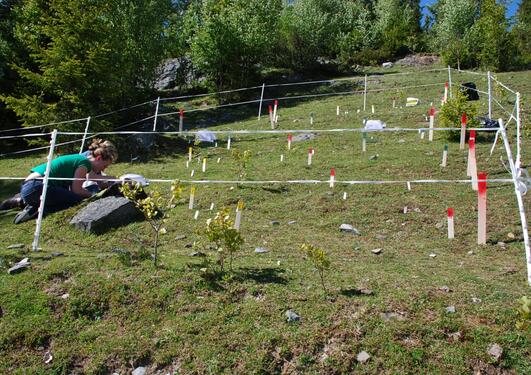
The TransPlant project is developing new methods that integrate observational and experimental approaches across broad-scale climate gradients to explore how climate--and climate change--affects the role of seed recruitment across four levels of organisation from direct physiological effects via demographic responses to population and community dynamics.
The RESEARCH CHALLENGES that are addressed in the TransPlant project are:
- Assess plant population and community responses to warmer and wetter/drier climates, and assess if, how and why these responses differ between high vs. low latitudes.
- Identify microorganisms involved in C and N cycling and assess how direct and indirect (i.e. through changes in the plant community) climate impacts microbial communities. Explore whether, how, and why microbial populations, communities, and responses differ between high vs. low latitudes.
- Assess impacts of warmer and wetter/drier climates on ecosystem-level processes such as productivity, decomposition, and biogeochemical cycling. Explore whether, how, and why these responses differ between high vs. low latitudes.
- Link responses of plant and microbial populations and communities via functional responses to biogeochemical cycles, allowing us to evaluate how lower-level effects scale up to ecosystem function and adaptability. Assess whether, how, and why these responses differ between high vs. low latitudes
The project involves Chinese and Norwegian biology students in collaborative research and education to meet these challenges. We will offer joint training course for Chinese and Norwegian students, followed by parallel field and lab work on similar field experiments and systems in Norway and China, leading to collaborative data analyses and writing of research papers. This project aims to train a new generation of Global Change Ecology students from BIO-UiB and IMHE-CAS, and the research outcomes will have implications for global change science and for habitat management and nature conservation strategies under climate change in both Norway and China.
Course 1: Integral projection models
Date: 6-10 October 2014
Deadline for applying: 17 August 2014
Course 2: Plant Traits
Date: 17-31 August 2015
Course 3: Microbial and ecosystem responses to climate change
Date: Autumn 2015, to be confirmed
Haijun Cui from the Institute of Mountain Hazards and Environment will be visiting the EECRG from May to August 2014. He will be learning new skills such as research design and coding in R and exchanging knowledge about Chinese ecosystems.
vv_transplanting.jpg

twoturves.jpg

-
SeedClim
The role of seeds in a changing climate - linking germination ecophysiology to population and community ecology