Building Bridges in the Mobile World
 Under this motto, the inaugural International Conference and Exhibition on NEXT GENERATION MOBILE APPLICATIONS, SERVICES and TECHNOLOGIES (NGMAST 2007) was held 12-14 September, in Cardiff, Wales, UK. The conference aimed at bringing together people from telecom and IT, which, traditionally, have played on separate fields. Also part of the vision, it should “facilitate a dialogue between Government, SMEs, major industry players and academia to help create pathways for the development of common goals in a convergent network environment.” Thinking back, the organizers definitely reached their goals; delegates from 28 countries and 41 interesting papers on various topics.
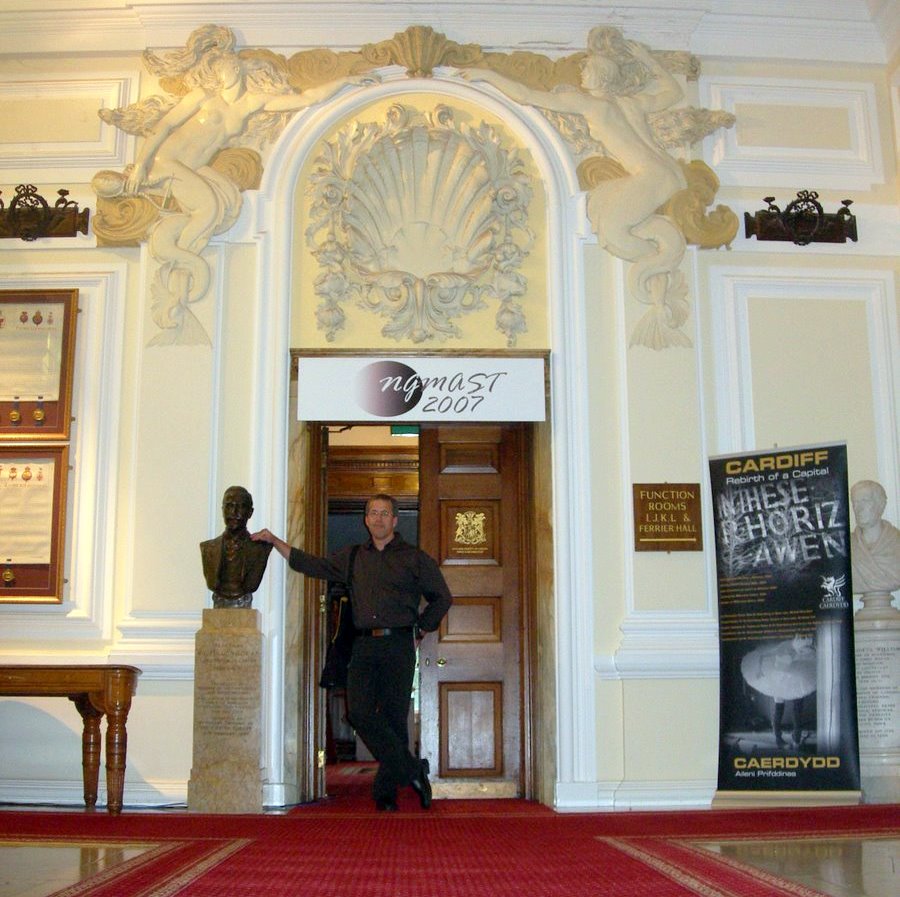
 Harald and Gunnar attended, and presented their paper “Users Are Doing It For Themselves: Pedestrian Navigation With User Generated Content“, co-authored with Håkon Holmstedt.
The keynotes
 Two of the keynote speeches touched directly on “our” theme, user generated content. Microsoft Research’s Tim Regan reported from research into mobile TV, and how consumer’s expectations are not necessarily obvious. He pointed out the role of user generated content in the context of mobile TV, and the social side of media. To illustrate the latter, he talked about content’s half life, whereby the value of content decreases rapidly after it has been published. He argues that mobiles will play a role in the “social trafficking of media”.
 Eric Burger, deputy CTO of BEA systems, has an extensive background from telecom, and used his keynote “The Environment Is The Application – It Really Is All About Web 2.0“ to share his visions of the users as active contributors in future services, both as content creators and as application developers. One of his claims was that the concept of User Generated Content will gradually evolve into User Generated Applications (and services), indeed a thrilling scenario which really could turn things upside down on the internet and in the corridors of large and dominating players. User generated applications might not be that exotic, just think of all the map mashups, and take a look at Yahoo Pipes.
The papers
Here we briefly highlights some of the papers touching our own field of research and/or interest.
Stålnacke et al.: Lean and active virtual meetings
 Marika and some of her colleagues from Ericsson AB, Sweden, are exploring the concept of a mobile based conferencing system. They are following a gentle and non-disruptive development by adding functions to augment standard mobile voice conferences into virtual meetings, where people (easily) can share multimedia content like documents, snapshots etc. Their main goal is to develop a service that is easy to use. This would be an extremely useful tool, and I was thinking all the time during her presentation: Why haven’t somebody done this before?
Landstorfer, Pschetz et al.: SocialButton - Mobile Technology Enhancing Social Interaction
Larissa and Johannes, master students from University of Applied Sciences, Potsdam, Germany, presented the Social Button, a phidget (physical widget) which might make it easier to get in touch with strangers. In short, the wearable device have access to an enhanced addressbook, and is able to search the contact list of nearby persons (buttons). If common friends are found, the buttons display the the symbol representing this person, then it’s up to the strangers to make contact. Nice concept, but perhaps not easy to implement, neither technically nor social-wise.
This was the students’ first academic paper, and it also was accepted at MobileHCI in Singapore. Good work from the young students, who also contributed throughout the conference with questions, comments and good humour!
Adelmann: Mobile Phone Based Interaction with Everyday Products – On the Go
Robert (ETH, Zurich) demonstrated an incredible efficient barcode reader for mobile phones, implemented in Symbian C++. Real time on-board recognition with on-line database queries to supply feedback - for example if a product in the grocery store contains elements that you are allergic to - well, just impressive! It’s a good example of using the computing capabilities of a modern smartphone to perform non-trivial tasks on the device itself. Have a look yourself in these videos. He also demonstrated have to use the same image recognition algorithms to detect movement and use this as an additional input feature. As Robert concluded: There’s a lot of interesting and useful application that could be built with this technology, - so just start using your imagination!
Some of the software is available in the BaToo - Barcode Recognition Toolkit, have to test it someday!
Pallotta et al.: Kinetic User Interfaces for Flexible Mobile Collaboration
By using the case of the intelligent fridge (!), Palotta demonstrated a framework for mobile collaboration. The fridge was equipped with RFID tags, keeping track of it’s content. The users carried mobile phones with GPS’es, and would for instance receive a message from the fridge if they passed the grocery store and the fridge was out of milk.
A key feature of the system is the Kinetic User Interface (KUI), in the sense that the user interaction adapts to the kinetic context of the user: If the user is moving fast when passing the shop, the fridge will not send the request for buying milk, assuming that the user is in a hurry and don’t have time for shopping.
Mobile collaboration seems to open a large field of applications, just think of it: When you’re mobile, you often have a purpose, a destination, a goal, …and often other people are included in your agenda: “Hi, I’m just 5 minutes late…”, or “Where are you now? Is it OK for you to pick up the kids today?”.
Menkens et al.: IMS Social Network Application with J2ME compatible Push-To-Talk Service
SoCoNet, developed by Menkens and three fellow master students from Georgia Institute of Technology, Atlanta, US, is a social campus community network that gives students access to lecture materials, campus events and location-based social networking.
SoCoNet won the Grand Prize in the Forged By IMS Research Competition, sponsored by Nokia Siemens Networks and AT&T. Now, steady yourselves and put your coffee down on the table: the prize was $35,000 and an internship offer at Nokia Siemens Networks, and in total cash prices for one hundred thousand US dollars were awarded to students. Citing the press release:
To develop these applications, students utilized the 3G/IMS laboratory at GeorgiaTech, a $5 million state-of-the-art communications lab that opened 2006 through a co-sponsorship by Nokia Siemens Networks and AT&T. The lab serves students and researchers as a test bed for the creation of third generation IP Multimedia Subsystem (IMS) convergence applications and services that bring together audio, video and data over a variety of networks.
…puh, yes, there’s money in the telcom business, for sure.
Btw: One of the reasons for the Integrated Communication Research Centre of the University of Glamorgan to arrange this conference, was to draw attention and potential collaborators to their IMS lab, heavily supported by major players such as the mobile operator Orange®, Ubiquity Software Corporation, Cantata Technologies and Voxpilot.
And if you still wonder what this IMS is, well, this is the short version, according to Wikipedia:
The IP Multimedia Subsystem (IMS) is an architectural framework for delivering internet protocol (IP) multimedia to mobile users. It was originally designed by the wireless standards body 3rd Generation Partnership Project (3GPP), and is part of the vision for evolving mobile networks beyond GSM.
The venue
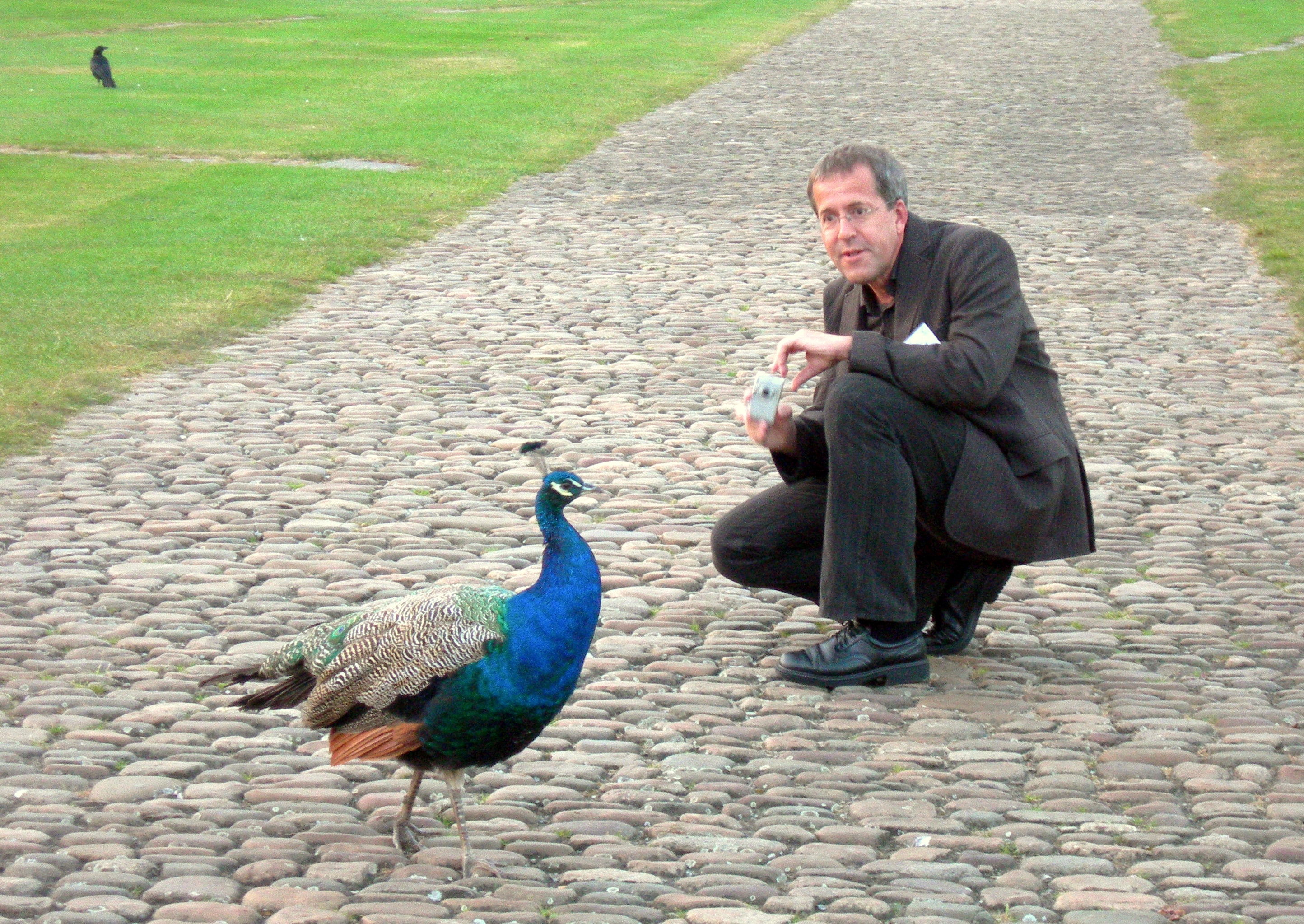

 The venue was spectacular. The organizing committee headed by Khalid Al-Begain had made tremendous efforts in making the conference a memorable happening. The conference was held on the premises of the old city hall in Cardiff, with its abundance of marble, stained glass windows, statues and large format portraits of royal dignities. The city major held a welcome speech, and we were treated with a Cardiff banquet in the cellars of the the old castle, entertained by a singing kitchen staff and a crash course in the tongue wrenching welsh language. We also got mandatory mug shots of the castle peacocks.
Best Paper Award
 To our surprise (and delight), we won the best paper award. The award was based on the ratings from the referees. Indeed, for a small research group in a small university college in a small town in a small country, it’s a great boost and inspiration to receive such an award!


