|
Welcome to Department of Sociology.
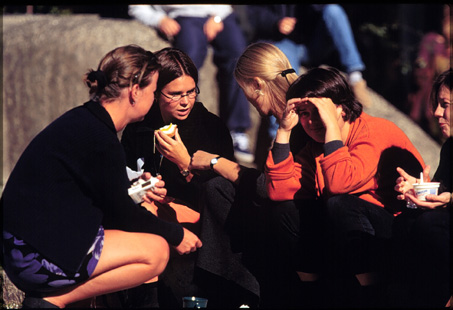 |
| Debate in the labyrint |
The department of sociology has priority in giving the students good competence in sociological theory and methodology. We offer teaching at all levels; from foundation subject to doctorate, or more correctly, from bachelor-level to doctorate. The degree system was changed autumn 2003 and we introduced the new study programs; Bachelor’s Programme, Master’s Programme and Ph.D Programme in sociology.
The academic strengths of the department are within medical sociology, sociology on the welfare state and theories of modernity in addition to the general parts of the discipline. The range of courses offered is also covering other topics within sociology, including cultural sociology, family sociology, feminist sociology, scientific sociology/ scientific theory and research ethics.
Sociology is the science on human co-existence, as it is expressed on a global level, national level or in social units of various sizes, down to small groups and individuals. The main focus is on the study of present social and (inter-)human relationships in industrialized countries, but sociologists also show great interest for development and periphery problems.
Sociology studies the internal structure and activity of different social units and the tendencies of conflict and solidarity, interest and power relations than characterize these units. It also high lights interaction and conflict between social units. Sociology tries to understand different kinds of societies and each group’s peculiarity, and how social relations are conditioned by, as well as influence economic, technological and cultural conditions.
Sociology looks at the problems and challenges of societies and individuals; class struggle, violence, drug abuse, unemployment in the light of basic social relations. Many sociologists try to contribute to a critical and constructive understanding of the society in the population in order to achieve awareness of those conditions that create solidarity and adherence in and between societies.
This relates to the relationships between genders, social classes, between the rulers and the rules, between cultural groups or peoples, in the labour market, in private and public care services, in the schools, neighbourhood and in the social use of punishment and reward.
|


