|
Integrated optics
4
Integrated optics: µMove
Our research on integrated optics is concentrated on the project MicroMove. We plan to build a lab-on-chip device that integrates active optical functions for manipulation, detection and sorting of micro- and nanoparticles. Optical guiding on top of a waveguide will be used to manipulate the particles. They will be separated based on size, refractive index or spectroscopic properties. This allows us to sort the particles that are of interest for further (optical, biological or chemical) analysis. We have close collaboration with Professor James Wilkinson, ORC, University of Southampton, and we participate in "Nanostructures for optics", funded by the NANOMAT-program.
Principle
A high-power laser is used to send light through an optical waveguide. On the surface of the waveguide there is an evanescent field. Radiation pressure forces act on particles found in this evanescent field. The gradient force attracts the particles toward the point of the highest intensity, thus down to the surface and the centre of the waveguide. At the same time the scattering force, dependent on the power of the laser light, propels them along the waveguide. Particles are thus confined laterally on top of the waveguide and can be moved forward with a controlled speed. Radiation pressure at work is illustrated very well in the video record of one of our experiments (1.6 MB movie, Movie1.mpg, Figure 4).
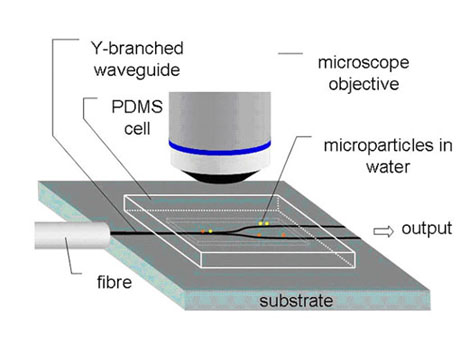 |
| Figure 1. Setup for optical guiding of microscopic particles. |
Results
We have successfully trapped and propelled dielectric microparticles and gold nanoparticles. When working with polystyrene particles we have observed that they easily form chains. Figure 3 and 4 illustrate the formation of one such chain. For the same input power the speed of particles increases with the diameter. We have also simulated the forces on the particles (based on Mie-scattering), and found good agreement between simulations and experimental results (see the list of relevant articles).
A simple Y-branched waveguide structure as shown in Figure 1 can be used to sort particles. Changing the position of the input fibre changes the evanescent field distribution and thus sends a chosen particle down the desired output waveguide branch.
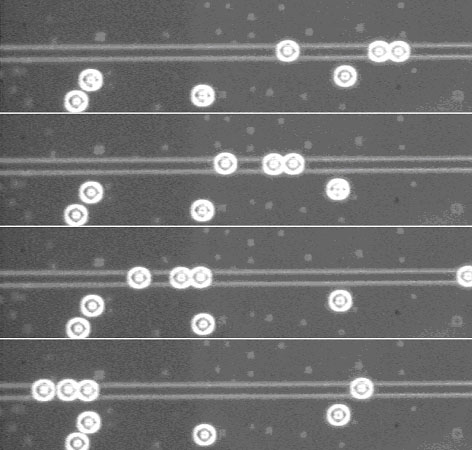 |
| Figure 2. Sequence of images illustrating a chain formation of polystyrene particles propelled on top of a waveguide. Laser light was launched from the right hand side. |
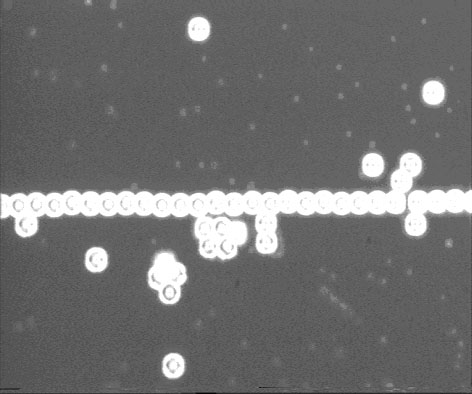 |
| Figure 3. Long chain formed of 7 µm diameter polystyrene particles. |
Clikk Figure 4. to run a movie of a rotating cluster of three 10 µm diameter particles and a 4-particle chain propelled on top of a waveguide.
Some relevant articles:
K. Grujic, O.G. Hellesø, J.S. Wilkinson and J.P. Hole, “Optical propulsion of microspheres along a channel waveguide produced by Cs+ ion-exchange in glass”, Optics Communications, 239, 227-235 (2004)
H. Jaising and O.G. Hellesø, “Radiation forces on a Mie particle in the
evanescent field of an optical waveguide”, in preparation.
K. Grujic, O. G. Hellesø, J. P. Hole, and J. S. Wilkinson, "Sorting of polystyrene microspheres using a Y-branched optical waveguide"
Optics Express, 13 (1-7) 2005
Contact
If you are interested in more information, collaboration, PhD- or MSc-projects, please contact Olav Gaute Hellesø
|


