|
Boathouse Research at Borg
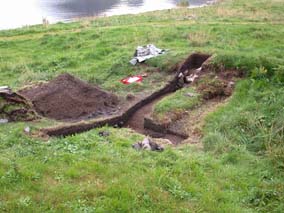 |
| Boathouse excavation in 2004 |
Stephen Wickler is currently investigating boathouses at Inner Borgpollen, a brackish water lake that was a harbour for the Iron Age power centre at Borg on Vestvågøy. This work is part of a larger project documenting the maritime cultural landscape at Borg that began with waterborne geophysics and underwater archaeological surveys of Inner Borgpollen in 2001 and 2002. The scope of field investigations has since been expanded to maritime archaeological remains on land.
In 2003, a cluster of three Iron Age boathouses along the western shore of Inner Borgpollen was documented by micro-topographical total station mapping and geophysical survey. The survey results provided a basis for ongoing test excavations in two of the boathouses, which are the largest at Borg/Borgpollen with interior lengths of approximately 21 m and 22 m. As with previous boathouse excavations on Vestvågøy, trenches were excavated perpendicular to the long axis of the structures between the walls in order to document both floor width and wall construction.
Despite the limited area excavated in each of the structures, a great deal of information concerning construction, function and chronology has already been gained. The relative abundance of material remains can be directly linked to field methods including the sieving of all matrix through 4 mm mesh and wet sieving of cultural deposits. This approach insured maximum recovery of charcoal and small finds such as flint flakes, slag from metal working, burnt animal bone and a textile fragment. Despite the fact that sieving has been a standard archaeological method for many decades, it has only been used in a small percentage of boathouse excavations in Norway and, to our knowledge, never before in northern Norway.
Construction details are similar to other boathouses on Vestvågøy with floor widths of 2.3 m and 3.6 m and walls over 2 m wide with inner stacked rock and outer peat components.
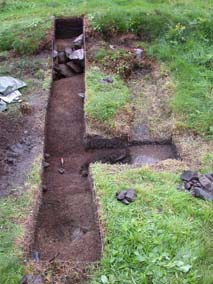 |
| Base of boathouse excavation trench in 2004 |
Cultural deposits are fairly thick (15-20 cm) with multiple cultural layers. Other evidence suggesting long-term use includes charcoal bands and hearths at different levels and superimposed pit and ditch features. Two radiocarbon dates have been obtained so far from one of the boathouses and additional samples are being processed from both structures. The existing dates support the stratigraphic evidence for long-term use with a basal date from the Merovingian Period and a date from the upper cultural deposit straddling the transition from the Viking Age to Medieval Period. This suggests that boathouse use was more complex and of much longer duration than is commonly thought.
 |
| Plan view of boathouse trench at base of excavation |
Collective results from the current excavations demonstrate that boathouses were used for much more than boat storage. Multiple cultural layers with dense charcoal concentrations, heat-altered rock and burnt bone suggest intensive use including activities such as food preparation. Slag provides evidence of metal working while whetstone fragments and assorted iron objects are indicative of various everyday tasks. The abundance of boat nails/rivets associated with boat maintenance is typical of boathouse excavations. The presence of multiple hearths and a deep pit with artefacts, charcoal and heat-altered rock also points to activities unrelated to boat storage. The pit feature is especially interesting as it extends below a central keel trench in the largest boathouse.
|


