Source: The National Bureau of Crime Investigation
The number of ecstasy seizures has increased since 1990. In 1994 the police
confiscated 969 doses of ecstasy and in 1996 the seizures was increased to
12,852. There where only 9 seizures in 1993 compered to 192 in 1996.
Approximately 30 % of cannabis and amphetamine seizures and approx. 70% of
heroin seizures are made in Oslo. The increase in drug seizures is partly the
result of new and improved police equipment, competence and more international
co-operation, but we also have reason to believe that smuggling of drugs into
Norway has increased. Simultaneously different international youth cultural
trends are directly or indirectly connected to more liberal attitudes towards
drug use, and these trends have influenced on Norwegian youth.
1.2 Drug use patterns
Cannabis is by far the most widely used illegal substance in Norway. Recent
increases in use have been reported and the average age among users seems to be
increasing. The typical addict combines the use of illicit drugs with alcohol,
prescription drugs and, sometimes, with organic solvents. Few drug addicts use
only heroin, but commonly consume large amounts of benzodiazepiens, rohypnol and
valium. Many addicts predominately use amphetamines, such as either eaten or
injected.
At the time being, heroin is available in most places in the country. In
Oslo supply is larger than demand. The price of heroin has been low since
1993/94. In spite of lower prices, the police, social workers and research
workers share the opinion that the heroin situation in Norway is relatively
stable. The average age of known addicts has been steadily rising. Observers
interpret this as indicating that the addict population consists of an ageing
cohort with few younger recruits. Even so, the situation is serious because of
the high rate of drug-related deaths. It seems that lower prices and higher
supply makes some heroin addicts use more heroin. New patterns of use such as
smoking and sniffing have been registrated.
Use of heroin has traditionally been concentrated to the Oslo-area. However,
in the recent years the abuse of heroin has been reported from other major
cities as well. Traditionally use of new drugs is first begins in Oslo and then
spread to other parts of the country. Ecstasy is an exception to this pattern.
After just a few years, ecstasy is available throughout the country.
Abuse of amphetamine has increased, especially among special groups of
youth, but also within more established social environments. Few people abuse
cocaine in Norway. The cocaine abuse is concentrated to a small and relatively
closed environment. Cocaine is furthermore considered as an "upper-class"
drug because it is expensive and difficult to obtain.
The extent of drug use varies considerably within the country. The drug
problem is greatest in the large coastal towns, and less pronounced in rural
areas. Drug use seems to be twice as extensive in Oslo than in Norway as a
whole. We have no exact data on the number of drug users. What we do have is an
estimate. At present there are approximately 5500-7000 active Intravenous drug
abusers in Norway. The main drugs injected are heroin and/or amphetamines. It is
estimated that about 30% of injecting drug abusers are female and 70% male.
1.3 Survey of drug and alcohol use among young people in Oslo and Norway
Since 1968 The National Institute for Alcohol and Drug Research has carried
out a survey among young people in Oslo - to determine their use of and
attitudes towards cannabis and other drugs. Since 1986, data have been collected
every other year in the country as a whole.
Data are obtained from questionnaires distributed to a representative sample
of young people in aged 15-to-20 years.
Fig 3 Percentage of young people in Oslo and Norway who say
that they at some time have used different drugs in 1996

Source: The National Institute for Alcohol and Drug Research
The studies have shown that the use of illicit drugs is about twice as
common in Oslo as in the country as a whole. Cannabis is the most widely used
drug. The numbers show that about 23.7% of young people aged 15-20, in Oslo have
tried marihuana and hashish at least once. The number for the same age group in
the rest of the country is 12.4% in 1996. According to the surveys, a very small
group of young people have ever injected drugs - mostly heroin, but also
amphetamines.
Attitudes towards drug use are generally negative. Only 9% of 15 - 20 year
olds in 1996 believed that marihuana and hashish should be sold freely in
Norway. The percentage of young people who believe that cannabis should be sold
freely has increased steadily from 2.1% in 1986 to 11.4% in 1996. At the same
time the numbers show that more young people would try cannabis if there were no
risk of being arrested( 5.0% in 1986 and 16.6% in 1996).
1.4 Drugrelated deaths
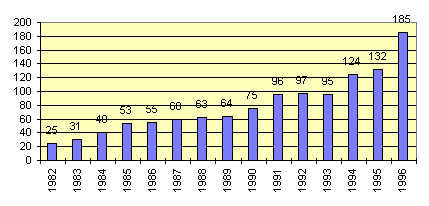
The number of drug-related deaths increased steadily during the 1980s, and
rose more sharply in the 1990s. 185 deaths from overdoses were registered in
1996, 159 men and 26 women. The average age at death was 34.9 years for men and
33.2 for women.
Fig. 4 Deaths caused by use of drugs, 1982-1996
Source: The National Bureau of Crime Investigation
1.5 HIV/AIDS
By the end of 1996, a total of 406 injecting drug addicts where registered
as being HIV antibody positive. The spread of HIV infection among injecting drug
addicts has gone down markedly since 1986. By the end of 1996, 7 injecting drug
users had been given the diagnosis of AIDS.
Tab. 5 HIV infection, number of cases diagnosed, by risk factor and year
of diagnosis
Source: National Institute of Public Health
The Ministry of Health and Social Affairs is the responsible
ministry for alcohol- and drug policy and the overall co-ordination of illicit
drug abuse.
Norwegian Directorate for the Prevention of Alcohol and Drug Problems
shall, after special instruction from the Ministry of Health and Social Affairs
"give its full attention to all social conditions that are related to
trends in consumption of legal and illicit drugs and the consequences of their
use, and develop and implement measures that prevent these problems."
The National Institute for Alcohol and Drug Research (SIFA) is an
independent institute whose aim is to carry out scientific research on alcohol
and drug issues with special attention to social science research.
A permanent co-ordinating body for law enforcement activities has been
formed, comprising a representative for the Ministry of Justice and Police, the
Director of Public Prosecutions, the Chief of the National Bureau of Crime
Investigation and the Head of the Drug Section, Oslo Police force. This
committee keeps abreast of the development in drug use, continuously evaluates
law enforcement efforts, ensures that resources are available and from an
assessment of priorities, select specific issues to concentrate on.
In order to co-ordinate the drug law enforcement of the police and the
custom service, a body comprising representatives from both agencies has been
formed. This body deals with questions of overall policy as well as practical
measures involving the two agencies. A custom task force with liaison to the
police has been established at the international airport in Oslo, equipped with
advanced technology and a computerised information system.
3.1 Basic approach of legal policy
All illicit dealings with drugs are covered by the Norwegian Penal Code.
Confiscation of proceeds, telephone tapping, control of mail under certain other
investigation procedures are allowed under certain conditions by Norwegian law
and regulations.
Two government-appointed committees have recently presented their
recommendations to the Ministry of Justice on respectively improving the
legislation on the confiscation of the proceeds of crime and the improvement of
investigation procedures in order to combat crime.
3.2 and 3.3 Legislation/penalties concerning production, consumption,
possession and trafficking of drugs
All unlawful dealing with drugs are covered by § 162 of Penal Code,
with the exception of the use and possession of minor quantities of drugs which
is penalised through the Medicines act. There has been no significant changes in
our drug legislation since our last report.
3.4 Legislation/penalties concerning the unlawful trafficking in precursors
and essential chemicals
No major steps have been taken since our last report.
3.5 Legislation/penalties concerning the seizures of the financial proceeds
from drug offences, money laundering etc.
As mention above a government appointed committee has recently delivered its
report on this issue, and the proposals will be carefully considered on order to
find means to make the work in this field more effective.
3.6 Assessment of current legislative situation possible proposals for
reform under discussion
Norwegian penalties for narcotic crimes are among the strictest in Europe
and the investigation and prosecution of narcotic crimes are given high priority
by the police and prosecution services.
4.1 Organisation of police services
The local police districts are co-operating closely with central units. The
National Bureau of Crime Investigation (NBCI) has a central function when it
comes to the exchange of information as well as analyses of narcotic substances.
Intelligence, tactical analyses, strategy plans, preparation of statistical
material as well as professional assistance are the most important support
functions. National database and communication with other countries are arranged
via the NBCI. Communication with the 28 Nordic liaison officers posted in
strategically important countries for Norway is also channelled via the NBCI.
The police and Customs Co-ordinating Office, manned with personnel form both
services, is an important resource.
The National Authority for Investigation and Prosecution of Economic and
Environmental Crime in Norway (ØKOKRIM) is a national, central unit
concentrating its activities on economic investigation. It is a resource for the
police districts in terms of economic investigations. The unit has a separate
group specialised in detecting money laundering. The group has proved its raison
d'être on several occasions. Among other things, it has been used in cases
with international ramifications.
Oslo Police Headquarters has the responsibility for operational assistance
for all of Norway. The Drug section, with its personnel and material resources,
assists the police districts as needed in the fight against drug crimes. The
Drug Section co-operates with the police districts in towns and densely
populated areas which have serious drug problems. This is done in connection
with drug actions planned in advance.
The Ministry of Justis has initiated various regional projects in areas in
Norway where the need has been visualised. If co-operating, closely in order to
solve persistent drug problems comes naturally to several police district,
centrally initiated projects are implemented in which a joint undercover group
is included. Projects of this type have proved to be efficient. Resource
exploitation improves and the detection rate for drug crimes increases. Projects
which receive central working capital, are evaluated on a annual basis. Changes
in the need for such projects are considered, and on that basis changes in
composition as well as the number of projects are implemented.
The Mobile Police is a resource which covers the entire nation through daily
patrols. The officers in the Mobile Police obtain a theoretical background on
drug issues as a part of their basic training. Liaisons are appointed in the
various police districts, and they provide the officers of the Mobile Police
with information. The liaisons are also used in connection with major drug
actions. Traffic controls with a view to detecting car drivers influenced by any
type of intoxication are also arranged. Controls of this type are held over an
extended period of time with resources from the Mobile Police and local police
districts.
4.2 Organisation of customs service
The Customs shall still give priority to detecting and preventing the
importation and exportation of narcotic substances, profit obtained from drug
crimes, doping preparations and chemicals used in connection with the illegal
production of narcotic substances. The plan focuses on the following strategies:
reorganisation, target action, co-operation, increasing competence, and
technical aids.
The reorganisation of check activities has come far in areas where mobile
units giving priority to drug checks have been used. These units can also be
used for other checks. Up to year 2000, a reinforced information service will be
built up.
The total use of resources in 1996 was increased with 57 man-labour years to
1700 man-labour years. As essential part of the new man-labour years has been
used within the area of drug check reinforcement.
The tip telephone established in 1990 has proved to be a measure which
yields valuable intelligence.
The Customs has entered into bilateral collaboration agreements with a
number of countries. Their participation in projects under the direction of the
World Customs Organisation and co-operation with foreign customs authorities
work satisfactorily.
4.3 Co-operation between customs and police services
In 1996, co-operation between police and customs authorities was
characterised by the at times significant seizures made in connection with
customs checks. The seizures where among other things made as a result of the
close co-operation between customs and police services.
In 1994, the established collaboration unit for police and customs services
was expanded to cover all cases of illegal importation, exportation and transit.
Based on experience gained from this co-operation, a working group was
established which is to review the similar working areas of the two services, as
well as the conditions of co-operation which are practised between the two
services.
Under the direction of the PTN, Police and Customs Co-operation in the
Nordic Countries, the two services collaborate in connection with different
projects on a Nordic scale in order to reveal the flow of narcotic drugs across
national borders, new tendencies and trafficking methods. Current problems are
discussed in connection with the regular PTN meetings, and new resolutions are
made.
4.4 Assessment of current effectiveness of law, enforcement
services/problems areas/possible proposals for new policies under discussion
The Norwegian Police Academy offers three years of basic education and
training, with a combination of theory and practice of which the topic of
intoxication is an important part.
In 1996, a task group for narcotic drugs was established, with members from
the central police institutions, police district and the Ministry of Justice.
The task group is to make proposals for new measures which can be initiated in
order to increase the efficiency of the fight against narcotic drugs.
In 1997, liaisons from the main police headquarters in the different parts
of Norway will be seconded to the National Bureau of Crime Investigation and act
as connecting links. This arrangement will strengthen the exchange of
information.
The Nordic meeting for national chiefs of police/deputy chiefs of police
consider cases relating to Nordic police co-operation. The national deputy
chiefs of police, who meet on a regular basis, develop and reinforce Nordic
police co-operation.
5.1 Organisation and policy of services responsible for information on drug
misuse
The official aim is to ensure that the public shall have access to
information, access to the results of research and understanding of political
measures to control the abuse of drugs. Norway has chosen a combined approach to
alcohol and drugs. In the field of demand reduction this is appropriate, though
it is necessary to stress differences in legality/illegality.
Drug research is carried out in several research institutions: The National
Institute for Alcohol and Drug Research (SIFA),The National Institute for
Forensic Toxicology (SRI) and The Norwegian Social Research Centre - NOVA
5.2 Organisation and policy of services responsible for education in
schools
Primary and secondary schools play an important role in preventing drug use.
Schools have responsibility for drug education, and they often co-operate with
voluntary organisations, treatment centres, former drug addicts and the police.
Furthermore they are assisted by the Ministry of Education, Research and Church
Affairs and the Norwegian Directorate for the Prevention of Alcohol and Drug
Problems.
There are several different national programmes on prevention of alcohol and
drug problems for use in educational institutions at several levels. The
programmes include education for teachers, so that they can, to a greater
degree, and more systematically, contribute to preventive drug education among
children and adolescents.
5.3 Organisation and policy of services responsible for other prevention
activities
The need for creating positive alternatives to drug use are strongly
emphasised. Special state grants and loans are available for this purpose. These
activities are mostly organised by the municipalities and voluntary
organisations.
In Norway there is a national programme to prevent the abuse of alcohol and
drugs at the work place, AKAN (The Tripartite Committee for the Prevention of
Alcohol and Drug Problems at the Workplace).
AKAN was founded in 1963 by representatives of the Norwegian Trade Union
Confederation (LO) and the Confederation of Norwegian Business and Industry
(NHO).
The programme has a tripartite funding, and works through the co-operation
of LO, NHO and national authorities. AKAN committees and programmes have been
set up in numerous public and private workplaces.
5.4 Prevention of HIV infection among drug addicts
Efforts to combat the AIDS epidemic are based on inter/cross-sectional
efforts, where the health sector works in close contact with all implicated
actors. The Directorate of Health is the professional co-ordinating body at the
central level.
Oslo has a needle exchange service, which is called "The AIDS
information bus". From the bus addicts can get free needles, condoms
and if they wish take an HIV-test. In 1996 the needle exchange service gave out
1,145, 120 needles and it had approximately 230 visitors every night.
6.1 General principles of treatment and rehabilitation policy
The main principle in Norway is that treatment should be voluntary and drug
free. Nevertheless, it is now accepted that people may benefit from compulsory
treatment. The Child Welfare Act of 1992 covers compulsory placement of young
people under the age of 18. The Act on Social Services provides the legal
framework for compulsory treatment for adults (for up to 3 months) and pregnant
drug users until the child is born. Adults can be transferred from prison to a
treatment centre as part of their sentence. Supervision orders (probation) can
also be made for convicted drug addicts.
6.2 General organisation of services
Drug addicts have the same entitlement to public health-and social welfare
services as other citizens. Such services are established in all areas of
Norway. An important aspect of the treatment and rehabilitation policy in Norway
is to bring responsibility back to local communities. In the Parliamentary White
Paper number 69 (1991-92); "The delivery of services for substance
abuse" early intervention, welfare and health care, and community based
approaches are emphasised as being the most important areas to concentrate on
the years ahead. This means that responsibility for the economy, planning and
operation lies with the municipalities and the counties.
6.3 Types of treatment offered
A variety of treatment and rehabilitation approaches are offered, including
private institutions. In general, non-governmental organisations play an
important role in the efforts to reintegrate drug addicts into society.
Originally there was a clear distinction between residential institutions
for people with alcohol-and drug problems. This distinction still exists, but as
mentioned above there is an increasing group of addicts who use a "mixture"
of alcohol, legal drugs and illegal drugs.
The largest and oldest institution for care of people with drug problems is
the State Clinic for Drug Addicts, which comes under the Ministry of Health and
Social Affairs. In addition, there is a range of institutions which comes under
the health and social services run by the county councils, or else which are
owned by organisations which are funded by the public sector. Some of the
institutions are run by religious or humanitarian organisations, and each
patient is paid for from public funds.
6.4 Assessment of current programmes and possible proposals for change
The Norwegian network and centres of competence
In 1996 the Parliament agreed to establish seven regional centres of
competence. The centres are clinically based with connections to universities
and research institutes.
Within their region, the competence centres shall contribute to raising the
general level of competence and distribution of competence within both primary
and secondary treatment services for alcohol and drug abusers. The competence
centres shall develop and carry out further education programmes for personnel
within primary health and social services for alcohol and drug addicts. The
centres have national responsibility for the development of special competence
within special fields, and co-operate with the other centres in a Norwegian
network.
Areas of special competence:
- Abuse of alcohol and drugs within the Sami (aborigine) population.
- Young alcohol and drug abusers, treatment, early intervention and
prevention.
- Women's use and abuse of alcohol and drugs.
- Alcohol and drug abuse in the work place.
- Alcohol and drug abusers who are parents with children of school age,
and associated work with families.
- Alcohol an drug abusers who are pregnant or have children under school
age.
- Drug abusers with HIV/AIDS.
- Drug abusers on methadone programmes.
- Alcohol and drug abuse amongst immigrants and refugees.
- Alcohol and drug abusers who are deaf.
- Clients in the grey area between mental illness and alcohol and drug
abuse (dual diagnosis).
- The National documentation System
The Ministry of Health and Social Affairs have given the Norwegian
Directorate for the Prevention of Alcohol and Drug Problems mandate to develop a
National Documentation System. The documentation system is divided into three
parts;
- The national database was established in 1995. This is a national database
with information about administrative, economic, treatment and development
activities in the units.
- The national client stream register was established in May 1996. All
clients are registered when they are undergoing treatment. This information is
centralised and crypted once a year.
- National client statistics. These are statistics based on standardised
forms used by the therapists in direct contact with the clients. The form
includes questions about family relations, education, physical and psychiatric
condition, and behaviour related to the clients use of drugs, alcohol and
medication.
Norway has a well-developed network of voluntary organisations involved in
drug problems. Thousands of people make an important contribution , by working
voluntarily and giving economic support. However, this level of activity would
never have been possible without public support. In Norway, there is a high
level of co-operation between the private and the public sectors.
8.1 Co-operation within the United Nation system
Norway has ratified the Single Convention on Narcotic Drugs of 1961, the
Convention on Psychotropic Substances of 1971, and the UN Convention Against
Illicit Traffic in Narcotic Drugs and Psychotropic Substances of 1988.
Norway is one of the major contributors to the United Nations International
Drug Control Programme - UNDCP. The Norwegian contribution has primarily gone to
projects for crop substitution and rural development in producer areas, but in
recent years also to demand reduction projects. Norway has also for several
years supported aid work to voluntary organisations. Norway was a member of the
UN Commission on Narcotic Drug during 1992-95 and is presently attending the
session of the CND as an observer.
8.2 Regional co-operation and 8.3 Bilateral co-operation
Norway has ratified all the relevant European conventions including the 1990
convention on laundering, tracing, seizure and confiscation of the proceeds of
crime. Norway is presently preparing the ratification of the 1995 Council of
Europe Agreement on Interdiction at Sea.
Norway is a member of the ICPO-INTERPOL, the Customs Co-operation Council
and the Dublin group, and is presently holding the chairmanship of the Pompidou
Group.
Norway is also taking part in the Financial Action Task-Force and in the
increased co-operation between the Baltic Sea Countries through the Baltic Sea
Task Force on Combating International crime.
Norway is presently taking steps toward joining the Schengen co-operation
and has in this respect signed a co-operation agreement with the Schengen
countries on the 19. December 1996.
In 1995 Norway started proceedings for a membership at the European
Monitoring Centre for Drugs and Drug Addiction (EMCDDA). Norway is also a member
of the Nordic Council for Alcohol and Drug Research (NAD).
8.4 Liaison officers
As mention in previous reports Norway is taking part in the PNT liaison
officer co-operation. Since our last report Norway has stationed an officer in
Moscow, established an ambulating liaison officer in Murmansk, Russia.
This page was last updated May 12 1997 by the editors


