Welcome to the Ministry of Transport and
Communications
|
On
this pages we will give you a presentation of the Ministry's various
departments, subordinate agencies
and enterprises.
|
|
 Ministry of Transport and Communication
|
The
Ministry of Transport and Communications' functions can be grouped as follows:
- Policy
formulation: Preparation of cases to be submitted to the Storting, including
the government budget and revisions over the year; proposals for laws and law
amendments; plans for the transport and communications sector; and matters
related to the organisational set-up and affiliation of enterprises under the
ministry.
- Agency
and enterprise management: Implementation of guidelines and requirements laid
down by the Storting for the administrative bodies and enterprises for which
the ministry is responsible. Where the administrative bodies are concerned,
management consists in following up and checking that appropriations are spent
as intended, that laws and regulations are complied with and that each entity
has an organisational form suited to its functions. Where companies are
concerned, the ministry is responsible for administering government ownership
in the interest of both corporate profitability and the society at large.
- Administration:
Handling of matters under relevant legislation within the ministry's
jurisdiction, or on behalf of the central administration in general. Enquiries
from individuals or institutions, and matters circulated for comment by other
ministries etc., are also handled.
Subordinate
agencies and enterprises
As from 1. January 2003 the following
bodies are subordinate to the Ministry of Transport and Communications:
Six administrative agencies: Norwegian
Post and Telecommunications Authority, Norwegian Railway Inspectorate, Civil
Aviation Authority, Accident Investigation Board/Norway, Norwegian National
Rail Administration and The Public Roads Administration.
And three state-owned companies: Norway
Post, Norwegian State Railways and Avinor
AS. Det Norske Veritas is
responsible for inspection of cableways in accordance with the authority
delegated by the Ministry of Transport and Communications
Norwegian Post and Telecommunications Authority (administrative agency)
Norway Post (wholly state-owned company)
Norwegian Railway Inspectorate (administrative agency)
Norwegian National Rail Administration (administrative agency)
Norwegian State Railways (wholly state-owned limited company)
Civil
Aviation Authority (administrative agency)
Accident Investigation Board / Norway(administrative
agency)
Avinor AS (wholly
state-owned company)
The Public
Roads Administration (administrative agency)
Ministry
leadership
The Ministry of Transport and
Communications is headed by the Minister. The ministry's political leadership
otherwise comprises a State Secretary and one Political Adviser. The State
Secretary stands in for the Minister and can act on the Minister's behalf as
head of the Ministry. The Political Adviser's role is to lighten the workload
of and assist the Minister, but he/she has no formal role on a par with that of
the State Secretary.
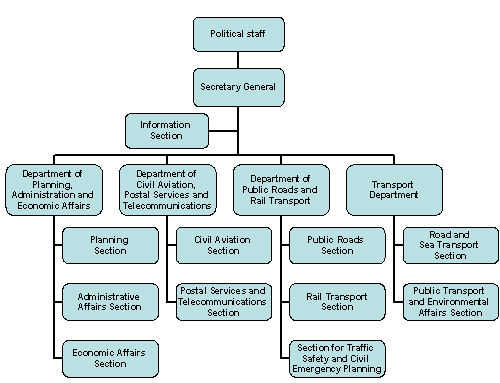
The Ministry of Transport and
Communications' administrative apparatus - the bureaucracy - is headed by the
Secretary General. The Secretary General is the principal adviser to the
Minister and other politicians in matters handled by the Ministry. The
Secretary General has directly below him/her four Director Generals, each in
charge of a Department and its respective sectors and specialist spheres. The
Information Section is a staff unit subordinate to the Secretary General.
Staff
and budget
As of
1 January 2003 the
Ministry had 135 employees: 32 managers, 93 advisers/executive officers and 10
office staff, and an operating budget of NOK 92,1 million.
Organisation Chart
|
�
Information Section
|
Coordination of the Ministryís press and information activities and management
of the professional information work. Communication counselling. Assisting the
media and helping to ensure compliance with the Freedom of Information Act.
Internal information tasks with an emphasis on keeping political staff informed
about media coverage of matters within the transport and communications sector.
Maintenance and development of the Ministryís internet pages.
Department of planning, administration and economic affairs
|
Planning
Section
Long-range
planning across transport sectors, particularly associated with preparation of
the National Transport Plan. Investigation and analysis of issues in all areas
of transport and communications. Competition between modes of transport and
framework conditions between transport sectors. Development of planning and
analysis tools. Study and planning of transport corridors involving two or more
modes of transport. Work on planning matters and Reports to the Storting (white
papers) from other ministries. Coordination and overall responsibility for
research and investigation conducted within the Ministry’s budget. International
matters with a main emphasis on planning and infrastructure, particularly
associated with the Trans-European Network (TEN) and the Barents Sea
Initiative. Coordination of the cooperation between the governments of the
Nordic countries in the area of transport and communications.
Economic
Affairs Section
Coordination
and control of the Ministry’s budgetary work, including the Ministry’s internal
budget. Joint matters in the area of finance, including general control
systems, financial instructions, powers of attorney, budget development and
presentation of accounts. Interpretation and application of rules for state
procurements, etc. Matters concerning the Office of the Auditor Generals not
dealt with by other departments.
Administrative
Affairs Section
Coordination
of the Ministry’s work on internal planning processes associated with
organizational planning and IT development. The Ministry’s administration of
pay and personnel matters, working environment, IT activities, library and
records.Personnel matters for subordinate agencies including matters of
principal concerning pay and working conditions, interpretation of legislation
and measures associated with major changes in the workforce.
Department of civil aviation, postal services and telecommunications
|
Civil
Aviation Section
Framework
conditions for civil aviation. Work on drafting of legislation. State ownership
interests in Avinor AS. Management, etc. of the Civil Aviation. Authority and
the Accident Investigation Board / Norway. Study, planning, finance and budget
matters. Tenders for regional air services. General legal matters, licensing,
appeals and interpretation matters pursuant to the Aviation Act. General work
on air safety.Aircraft noise and other environmental issues in civil aviation.
International aviation matters, including bilateral aviation negotiations and
EEA/EU civil aviation matters. International and Scandinavian civil aviation
cooperation.
Postal
Services and Telecommunications Section
Framework
conditions for post and telecommunications activities. Work on drafting of
legislation. Licences subject to post and telecommunications legislation.
Management of Norwegian Post and Telecommunications Authority. State ownership
interests in Posten Norge AS. Research and development within
telecommunications and IT. International cooperation in the area of post and
telecommunications.
Department of public roads and rail transport |
Public
Roads Section
Framework
conditions and control systems for the Norwegian Public Roads Administration. Management
of the Norwegian Public Roads Administration. Responsibilities associated with
planning, construction, maintenance and use of road infrastructure. Long-range
planning and budget work in the public road sector. Toll matters and road
financing. Environmental matters regarding the public road sector. International
road matters. Road Traffic Act and regulations and matters associated with the
Planning and Building Act.
Rail
Transport Section
Matters regarding rail transport and
cableways. Framework conditions for the railway sector. Drafting of
legislation. Management of the Norwegian Railway Inspectorate, the Norwegian
National Rail Administration and cableway inspection carried out by Det Norske
Veritas. State ownership interests in NSB
AS. Budget and finance matters,
negotiations concerning state purchase of railway passenger services. Analyses
and studies concerning the railway sector, international railway matters
including EU and EEA matters and international rail transport legislation.
Supervisory responsibilities. Long-range planning. General legal matters.
Appeals and interpretation matters pursuant to the Railway Act and the Act
relating to cableways and other legal and administrative matters. General
railway safety.
Section
for Traffic Safety and Civil Emergency Planning
Coordination
and control of work on safety across the various forms of transport. Coordination
and control of work on civil emergency preparedness in the Ministry’s sphere of
competence. Study, analysis and formulation of policy in connection with road
safety. Matters subject to road traffic legislation, the Act relating to
approval of car repair workshops and the Security Act.Management and
coordination of the Transport Readiness Council. International cooperation
within road transport and civil emergency preparedness.
Transport department |
Road
and Sea Transport Section
Framework
conditions for road and sea transport, pursuant to the Professional Transport
Act. Work on drafting of legislation. General legal matters, appeals and
interpretation of the Professional Transport Act. General purpose grants scheme
for counties and municipalities concerning transport and communications
matters, grants to the Coastal Express (Hurtigruten) and public road ferries,
including the state guarantee for public road ferries. International transport
matters, including bilateral contracts of carriage. General research and
development
Public
Transport and Environmental Affairs Section
Coordination
of the Ministry’s work on public transport and environmental issues. Studies
and analyses in connection with transport and communications and the environment,
including assessment of the use of instruments in relation to environmental
issues in the transport and communications sector. Studies and analyses in
connection with public transport issues in general, particularly measures aimed
at increasing the proportion of public transport. Tax policy matters,
particularly associated with environmental and transport taxes.International
public transport and environmental matters.
Subordinate agencies and enterprises
|
Norwegian Post and Telecommunications Authority
|
|
|
|
Norwegian Post and Telecommunications
Authority (Post- og teletilsynet)
The
Norwegian Post and Telecommunications Authority is a separate administrative
body with responsibility for administering legislation in the area of post and
telecommunications and for helping to ensure access to good and reasonably
priced post and telecommunications services for users in Norway.
The
responsibilities of the Norwegian Post and Telecommunications Authority
include: drafting and following up regulations, supervision of actors in the
area of post and telecommunications, standardization, granting and control of
licences, competition regulation, management of frequencies, authorization of
suppliers and installers and international work in the post and
telecommunications sector.
| Key figures |
| Appropriations over the government budget for 2002 |
| Revenues: |
NOK 159,3 million |
| Expenditure: |
NOK 169,3 million |
Employees (full-time equivalents) (2002): 174 |
Norway Post
|
Norway Post
is a wholly state-owned limited company. The Ministry of Transport and
Communications administers the ownership interests of the state and the
Minister of Transport and Communications functions as the company’s General
Meeting. Norway Post’s board of directors has nine members.
Norway Post is responsible for operating postal services and other
associated services. The company performs universal services and provides basic
banking services throughout the postal network, and is thus obliged to provide
efficient nation-wide postal services at reasonable prices and high quality.
The main activities are dissemination of information, transport of light goods
and performance of banking and payment transmission services for Postbanken.
By means of international cooperation, Norway Post provides efficient
postal services between Norway
and other countries. Norway Post is the parent company of the Ergo Group AS,
and has also ownership interests in a number of countries.
| Key figures |
| Appropriations over the government budget for 2001 |
| State purchase of postal services (2002): |
NOK 372 million |
| Turnover (2002, interim figure): |
NOK 15 167 million |
| Pre-tax result (2002, interim figure): |
NOK 718 million |
| Employees (full-time equivalentes, 2002): Approx. 23,500 |
Norwegian Railway Administration
|
The Norwegian National Rail Administration
is a separate administrative body with responsibility for operation and
maintenance of and investment in railway infrastructure. It is also responsible
for rail traffic control, distribution of track capacity between railway
operators and collection of track access charges from railway operators.
The budget of the Norwegian National Rail
Administration is part of the fiscal budget. The level of activity for the
Norwegian National Rail Administrationís operations, maintenance and investment
in railway infrastructure is based on long-range planning and the annual fiscal
budgets.
The Norwegian National Rail Administration
is organized as a head office and two organizational lines, respectively for
infrastructure and traffic. These are divided into local and regional
offices.The Norwegian
Railway Museum,
which is responsible for documenting and providing information on Norwegian
railway history, is also part of the Norwegian National Rail Administration.
|
Key figures
|
|
Fiscal
budget allocations for 2003
|
|
|
Operation
and maintenance of railway lines
|
NOK 3.0 billion
|
|
Investment
in railway lines
|
NOK 1.35 billion
|
|
Employees
(fulltime equivalents, 2002)
|
3
577
|
|
Norwegian Railway Inspectorate
|
The Norwegian Railway Inspectorate is a
separate administrative body with responsibility for ensuring safe and
appropriate operation of railways, including tramways and underground and
suburban railways. The inspectorate issues regulations, instructions, etc.,
permits for operation of railways and safety certificates to foreign operators.
It is also responsible for approval of rolling stock and routes, inspection,
including systems audits of the Norwegian National Rail Administration and
railway operators, and permits and market control of the Norwegian part of the
European railway system pursuant to the traffic coordination regulations.
|
Key figures
|
| Appropriations over the Government budget for 2003 |
| Total expenditure: |
NOK 21,2 million |
| Employees (full-time equivalentes): 18 |
Norwegian State Railways
|
NSB AS is a wholly state-owned limited company. The Ministry
of Transport and Communications administers the ownership interests of the
state and the Minister of Transport and Communications functions as the General
Meeting for the company.
The
NSB Group consists of the parent company NSB AS and nine partly or wholly owned subsidiaries,
including the rail freight carrier CargoNet AS
of which NSB owns 55 per cent. NSB owns 50 per cent of the Norwegian-Swedish
passenger transport operator LINX and 35 per cent of Celexa Property Investors. The board of directors of NSB AS
has eight members.
The
NSB Group is Norway’s
largest transport group. The group is divided into four business segments:
Passenger trains, bus transport, goods trains and property. The main activities
are passenger transport by train and bus and goods transport.
|
Key figures
|
|
Operating
revenues (2002)
|
NOK
7 710 million
|
|
Profit/loss
after tax (2002)
|
NOK
6 million
|
|
Public
purchase of services (2002)
|
NOK
1 386
|
|
Employees
(full-time equivalents, 2002)
|
7836
|
Civil Aviation Authority
|
Civil Aviation Authority
The
Civil Aviation Authority is a separate administrative body with responsibility
for ensuring that civil aviation in Norway is operated safely and
efficiently.
The
authority issues regulations, lays down standards for civil aviation activities
in Norway, grants licences and authorizes persons and companies that seek to
operate within civil aviation and related activities. One of its
responsibilities is issuing licences to pilots.
The
Civil Aviation Authority is also responsible for supervising and ensuring
compliance with regulations and conditions. Supervision is carried out, among
other ways, through system supervision and inspections of Avinor AS,
airlines, workshops and other operators and persons who perform civil aviation
activities. Producers and materials are also subject to supervision by the
authority.
|
Key figures
|
|
Fiscal
budget allocations for 2003
|
|
Operating
revenues (charges, etc.)
|
NOK
84,6 million
|
|
Operating
expenditure
|
NOK
120 million
|
|
Employees
(full-time equivalents, 2002):
|
145
|
Accident Investigation Board / Norway
|
Accident Investigation Board / Norway
The
Accident Investigation Board / Norway
is a separate administrative body subject to the authority of the Ministry of
Transport and Communications but, in all professional matters, is independent.
The
board has responsibility for investigating civil aviation- and railway
accidents and incidents. The purpose of the investigations is to reveal the causes of accidents and incidents, and to
provide recommendations for the improvement of air and railway safety. The
investigations do not aim to apportion blame or liability.
|
Key figures
|
|
Fiscal
budget allocations (2003)
|
NOK
20.2 million
|
|
Employees
(2003)
|
16.5
|
Avinor AS
|
Avinor
AS is a wholly state-owned limited company.
The Ministry of Transport and Communications administers the state’s ownership
interests, and the Minister of Transport and Communications functions as the
General Meeting for the company.
The
company is responsible for planning, operation and maintenance of civil
aviation infrastructure. Avinor
AS also provides airport and air
navigation facilities for airlines and other users of civil aviation
installations.
Avinor’s
responsibilities include:
- planning,
construction and maintenance of airport installations
- arrangement and production of services for
passengers and airlines
- services in the areas of information,
navigation and communications
- fire
prevention, accident and terminal services
Avinor
is organized in five regions, each with a regional director. The head office is
in Oslo.
Avinor’s board of directors has seven members.
Avinor
has two wholly owned subsidiaries: Oslo Lufthavn AS and Avinors
Parkeringsanlegg AS.
|
Key figures
|
|
Operating
revenues (charges, etc.)
|
approx.
NOK 2.5 billion
|
|
Operating
expenditure
|
approx.
NOK 2.5 billion
|
|
Investments
|
approx.
NOK 0.5 billion
|
|
Employees
(full-time equivalents, 2003) 2
900
|
Avinor
AS is a mainly self-financing company. Operating
costs and investment are thus in principle covered by operating income. For
2003, NOK 250 million has been allocated over the fiscal budget for the
purchase of airport services to maintain operations and investments at small,
commercially unprofitable airports. The major part of operating income is
derived from airport charges while the remaining income is derived from
business activities at the airports.
Public Roads Administration
|
Norwegian Public Roads Administration
The Norwegian Public Roads Administration
has responsibility for planning, construction, operation and maintenance of the
national and county road network and for supervision of vehicles and road
users. The agency also draws up provisions and guidelines for road design, road
traffic, driver instruction and vehicles. The agency is also responsible for
road ferries.
The Directorate of Public Roads is an
independent directorate under the Ministry of Transport and Communications and
is the head office of the Norwegian Public Roads Administration. Under the
Directorate of Public Roads, the Public Roads Administration is divided into
five regions each consisting of from three to five counties with a Regional
Road Office in each region. Each region is divided into districts, of which
there are 30 in
the country as a whole. In each district there is a District Road Office.
In national road matters, the Norwegian Public Roads Administration is subject
to the authority of the Ministry of Transport and Communications. In county
road matters, the regional road offices are subject to the authority of the
county authorities.
|
Key figures
|
|
Fiscal
budget allocations for 2003
|
|
Traffic
control, operation and maintenance of national roads, etc.
|
NOK
5 502 million
|
|
National
road investments
|
NOK
4 728 million
|
|
Compensation
for increased employer’s contributions
|
NOK
122 million
|
|
Grant
for national road ferry operations
|
NOK
1 091 million
|
|
Number
of employees, 1 January
2003
|
5 279
|
In
addition to national road investments over the fiscal budget for 2003, it is
estimated that approximately NOK 2 025 million will be made available from
road toll companies.

|