The Constitution
The complete text of the Constitution
|
THE PRINCIPLES
The Norwegian Constitution is founded on three principles
 The principle of the sovereignty of the people
The principle on the separation of powers
The principle of human rights
PARLIAMENTARISM
The Constitution states that "The King himself chooses a
Council from among Norwegian citizens who are entitled to vote"
(Article 12), but the principle of parliamentary rule has set
precedence in the Norwegian political system. This means that
in practice, the Storting has the authority over the executive
branch and that the government is accountable to the Storting
and dependent on its confidence.
|
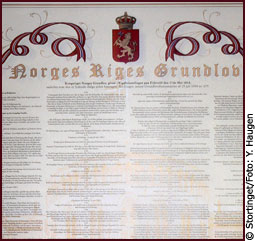
The Constitution of the Kingdom
of Norway |
CONSTITUTIONAL CHANGES
The Constitution of the Kingdom of Norway has been amended and some
articles changed, but due to a constitutional conservatism no major
revision has taken place. A proposal to amend the Constitution must
be submitted to the Storting during one of the first three years of
a parliamentary period which lasts four years. The proposal cannot be
considered by the Storting until one of the first three years in the
next parliamentary period. The people then have their say through the
election between the two parliamentary periods.
A proposal to amend the Constitution is considered by the Storting in
plenary session and at least two-thirds of the members of the Storting
must be present to constitute a quorum. Of these, at least two-thirds
must vote in favor of the proposal in order for it to be adopted.
The Constitution states in Article 3 that
"The Executive Power is vested in the King, or in the Queen...."
This is however not the case today. Due to parliamentarism the King
does no longer have any real power, but the language of the Constitution
has not been changed accordingly. Therefore, whenever it refers to the
powers of the King the actual powers lies with the Government. The original
language has been kept and is still used whenever a change or amendment
is made to the Constitution.
The Constitution of the Kingdom of Norway
The Constitution, as laid down on 17 May 1814 by the Constituent Assembly
at Eidsvoll and subsequently amended, most recently on 2 February 2006
A. FORM OF GOVERNMENT AND RELIGION
Article 1
The Kingdom of Norway is a free, independent, indivisible and inalienable
Realm. Its form of government is a limited and hereditary monarchy.
Article 2
All inhabitants of the Realm shall have the right to free exercise of
their religion.
The Evangelical-Lutheran religion shall remain the official religion of
the State. The inhabitants professing it are bound to bring up their children
in the same.
B. THE EXECUTIVE POWER, THE KING AND THE ROYAL FAMILY
Article 3
The Executive Power is vested in the King, or in the Queen if she has
succeeded to the Crown pursuant to the provisions of Article 6 or Article
7 or Article 48 of this Constitution. When the Executive Power is thus
vested in the Queen, she has all the rights and obligations which pursuant
to this Constitution and the Law of the Land are possessed by the King.
Article 4
The King shall at all times profess the Evangelical-Lutheran religion,
and uphold and protect the same.
Article 5
The King’s person is sacred; he cannot be censured or accused.
The responsibility rests with his Council.
Article 6
The order of succession is lineal, so that only a child born in lawful
wedlock of the Queen or King, or of one who is herself or himself entitled
to the succession, may succeed, and so that the nearest line shall take
precedence over the more remote and the elder in the line over the younger.
An unborn child shall also be included among those entitled to the succession
and shall immediately take her or his proper place in the line of succession
as soon as she or he is born into the world.
The right of succession shall not, however, belong to any person who
is not born in the direct line of descent from the last reigning Queen
or King or a sister or brother thereof, or is not herself or himself
a sister or brother thereof.
When a Princess or Prince entitled to succeed to the Crown of Norway
is born, her or his name and time of birth shall be notified to the
first Storting in session and be entered in the record of its proceedings.
For those born before the year 1971, Article 6 of the Constitution as
it was passed on 18 November 1905 shall, however, apply. For those born
before the year 1990 it shall nevertheless be the case that a male shall
take precedence over a female.
Article 7
If there is no Princess or Prince entitled to the succession, the King
may propose his successor to the Storting, which has the right to make
the choice if the King’s proposal is not accepted.
Article 8
The age of majority of the King shall be laid down by law.
As soon as the King has attained the age prescribed by law, he shall
make a public declaration that he is of age.
Article 9
As soon as the King, being of age, accedes to the Government, he shall
take the following oath before the Storting: “I promise and swear
that I will govern the Kingdom of Norway in accordance with its Constitution
and Laws; so help me God, the Almighty and Omniscient.”
If the Storting is not in session at the time, the oath shall be made
in writing in the Council of State and be repeated solemnly by the King
at the first subsequent Storting.
Article 10
(Repealed)
Article 11
The King shall reside in the Realm and may not, without the consent
of the Storting, remain outside the Realm for more than six months at
a time, otherwise he shall have forfeited, for his person, the right
to the Crown.
The King may not accept any other crown or government without the consent
of the Storting, for which two thirds of the votes are required.
Article 12
The King himself chooses a Council from among Norwegian citizens who
are entitled to vote. This Council shall consist of a Prime Minister
and at least seven other Members.
More than half the number of the Members of the Council of State shall
profess the official religion of the State.
The King apportions the business among the Members of the Council of
State as he deems appropriate. Under extraordinary circumstances, besides
the ordinary Members of the Council of State, the King may summon other
Norwegian citizens, although no Members of the Storting, to take a seat
in the Council of State.
Husband and wife, parent and child or two siblings may never sit at
the same time in the Council of State.
Article 13
During his travels within the Realm, the King may delegate the administration
of the Realm to the Council of State. The Council of State shall conduct
the government in the King’s name and on his behalf. It shall
scrupulously observe the provisions of this Constitution, as well as
such particular directives in conformity therewith as the King may instruct.
The matters of business shall be decided by voting, where in the event
of the votes being equal, the Prime Minister, or in his absence the
highest-ranking Member of the Council of State who is present, shall
have two votes.
The Council of State shall make a report to the King on matters of business
which it thus decides.
Article 14
The King may appoint State Secretaries to assist Members of the Council
of State with their duties outside the Council of State. Each State
Secretary shall act on behalf of the Member of the Council of State
to whom he is attached to the extent determined by that Member.
Article 15
(Repealed)
Article 16
The King ordains all public church services and public worship and all
meetings and assemblies dealing with religious matters, and ensures
that public teachers of religion follow the norms prescribed for them.
Article 17
The King may issue and repeal ordinances relating to commerce, customs,
all livelihoods and the police, although these must not conflict with
the Constitution or with the laws passed by the Storting (as hereinafter
prescribed in Articles 77, 78 and 79). They shall remain in force provisionally
until the next Storting.
Article 18
As a general rule the King shall provide for the collection of the taxes
and duties imposed by the Storting.
Article 19
The King shall ensure that the properties and regalia of the State are
utilised and administered in the manner determined by the Storting and
in the best interests of the general public.
Article 20
The King shall have the right in the Council of State to pardon criminals
after sentence has been passed. The criminal shall have the choice of
accepting the King’s pardon or submitting to the penalty imposed.
In proceedings which the Odelsting causes to be brought before the Court
of Impeachment, no pardon other than deliverance from the death penalty
may be granted.
Article 21
The King shall choose and appoint, after consultation with his Council
of State, all senior civil, ecclesiastical and military officials. Before
the appointment is made, such officials shall swear or, if by law exempted
from taking the oath, solemnly declare obedience and allegiance to the
Constitution and the King, although senior officials who are not Norwegian
nationals may by law be exempted from this duty. The Royal Princes must
not hold senior civil offices.
Article 22
The Prime Minister and the other Members of the Council of State, together
with the State Secretaries, may be dismissed by the King without any
prior court judgment, after he has heard the opinion of the Council
of State on the subject. The same applies to senior officials employed
in government ministries or in the diplomatic or consular service, to
the highest-ranking civil and ecclesiastical officials, commanders of
regiments and other military formations, commandants of forts and officers
commanding warships. Whether pensions should be granted to senior officials
thus dismissed shall be determined by the next Storting. In the interval
they shall receive two thirds of their previous pay.
Other senior officials may only be suspended by the King, and must then
without delay be charged before the Courts, but they may not, except
by court judgment, be dismissed nor, against their will, transferred.
All senior officials may, without a prior court judgment, be discharged
from office upon attaining the statutory age limit. It may be determined
by law that certain senior officials who are not judges may be appointed
for a term of years.
Article 23
The King may bestow orders upon whomever he pleases as a reward for
distinguished services, and such orders must be publicly announced,
but no rank or title other than that attached to any office. The order
exempts no one from the common duties and burdens of citizens, nor does
it carry with it any preferential admission to senior official posts
in the State. Senior officials honourably discharged from office retain
the title and rank of their office. This does not apply, however, to
Members of the Council of State or the State Secretaries.
No personal, or mixed, hereditary privileges may henceforth be granted
to anyone.
Article 24
The King chooses and dismisses, at his own discretion, his Royal Household
and Court Officials.
Article 25
The King is Commander-in-Chief of the land and naval forces of the Realm.
These forces may not be increased or reduced without the consent of
the Storting. They may not be transferred to the service of foreign
powers, nor may the military forces of any foreign power, except auxiliary
forces assisting against hostile attack, be brought into the Realm without
the consent of the Storting.
The territorial army and the other troops which cannot be classed as
troops of the line must never, without the consent of the Storting,
be employed outside the borders of the Realm.
Article 26
The King has the right to call up troops, to engage in war in defence
of the Realm and to make peace, to conclude and denounce treaties, to
send and to receive diplomatic envoys.
Treaties on matters of special importance, and, in all cases, treaties
whose implementation, according to the Constitution, necessitates a
new law or a decision by the Storting, are not binding until the Storting
has given its consent thereto.
Article 27
All Members of the Council of State shall, unless lawfully absent, attend
the Council of State, and no decision may be adopted there unless more
than half the number of Members are present.
A Member of the Council of State who does not profess the official religion
of the State shall not take part in proceedings on matters which concern
the State Church.
Article 28
Proposals regarding appointments to senior official posts and other
matters of importance shall be presented in the Council of State by
the Member within whose competence they fall, and such matters shall
be dealt with by him in accordance with the decision adopted in the
Council of State. However, matters strictly relating to military command
may, to the extent determined by the King, be excepted from proceedings
in the Council of State.
Article 29
If a Member of the Council of State is prevented due to lawful absence
from attending the meeting and from presenting the matters that fall
within his competence, these shall be presented by another Member temporarily
appointed by the King for the purpose.
If so many Members are prevented due to lawful absence from attending
that not more than half of the stipulated number are present, the requisite
number of other men or women shall be temporarily appointed to take
a seat in the Council of State.
Article 30
All the proceedings of the Council of State shall be entered in its
records. Diplomatic matters which the Council of State decides to keep
secret shall be entered in a special record. The same applies to military
command matters which the Council of State decides to keep secret.
Everyone who has a seat in the Council of State has the duty frankly
to express his opinion, to which the King is bound to listen. But it
rests with the King to make a decision according to his own judgment.
If any Member of the Council of State is of the opinion that the King’s
decision conflicts with the form of government or the laws of the Realm,
or is clearly prejudicial to the Realm, it is his duty to make strong
remonstrances against it, as well as to enter his opinion in the records.
A Member who has not thus protested is deemed to have been in agreement
with the King, and shall be answerable in such manner as may be subsequently
decided, and may be impeached by the Odelsting before the Court of Impeachment.
Article 31
All decisions drawn up by the King shall, in order to become valid,
be countersigned. Decisions relating to military command are countersigned
by the person who has presented the matter, while other decisions are
countersigned by the Prime Minister or, if he has not been present,
by the highest-ranking Member of the Council of State present.
Article 32
The decisions adopted by the Government during the King’s absence
shall be drawn up in the King’s name and be signed by the Council
of State.
Article 33
(Repealed)
Article 34
The King shall make provisions concerning titles for those who are entitled
to succeed to the Crown.
Article 35
As soon as the Heir to the Throne has completed her or his eighteenth
year, she or he is entitled to take a seat in the Council of State,
although without a vote or responsibility.
Article 36
A Princess or Prince entitled to succeed to the Crown of Norway may
not marry without the consent of the King. Nor may she or he accept
any other crown or government without the consent of the King and the
Storting; for the consent of the Storting two thirds of the votes are
required.
If she or he acts contrary to this rule, they and their descendants
forfeit their right to the Throne of Norway.
Article 37
The Royal Princes and Princesses shall not personally be answerable
to anyone other than the King, or whomever he decrees to sit in judgment
on them.
Article 38
(Repealed)
Article 39
If the King dies and the Heir to the Throne is still under age, the
Council of State shall immediately summon the Storting.
Article 40
Until the Storting has assembled and made provisions for the government
during the minority of the King, the Council of State shall be responsible
for the administration of the Realm in accordance with the Constitution.
Article 41
If the King is absent from the Realm unless commanding in the field,
or if he is so ill that he cannot attend to the government, the person
next entitled to succeed to the Throne shall, provided that he has attained
the age stipulated for the King’s majority, conduct the government
as the temporary executor of the Royal Powers. If this is not the case,
the Council of State will conduct the administration of the Realm.
Article 42
(Repealed)
Article 43
The choice of trustees to conduct the government on behalf of the King
during his minority shall be undertaken by the Storting.
Article 44
The Princess or Prince who, in the cases mentioned in Article 41, conducts
the government shall make the following oath in writing before the Storting:
“I promise and swear that I will conduct the government in accordance
with the Constitution and the Laws, so help me God, the Almighty and
Omniscient.”
If the Storting is not in session at the time, the oath shall be made
in the Council of State and later be presented to the next Storting.
The Princess or Prince who has once made the oath shall not repeat it
later.
Article 45
As soon as their conduct of the government ceases, they shall submit
to the King and the Storting an account of the same.
Article 46
If the persons concerned fail to summon the Storting immediately in
accordance with Article 39, it becomes the unconditional duty of the
Supreme Court, as soon as four weeks have elapsed, to arrange for the
Storting to be summoned.
Article 47
The supervision of the education of the King during his minority should,
if both his parents are dead and neither of them has left any written
directions thereon, be determined by the Storting.
Article 48
If the Royal Line has died out, and no successor to the Throne has been
designated, then a new Queen or King shall be chosen by the Storting.
Meanwhile, the Executive Power shall be exercised in accordance with
Article 40.
C. RIGHTS OF CITIZENS AND THE LEGISLATIVE POWER
Article 49
The people exercise the Legislative Power through the Storting, which
consists of two departments, the Lagting and the Odelsting.
Article 50
Those entitled to vote in elections to the Storting are Norwegian citizens,
men and women, who, at the latest in the year when the election is held,
have completed their eighteenth year.
The extent, however, to which Norwegian citizens who on Election Day
are resident outside the Realm but who satisfy the aforementioned conditions
are entitled to vote shall be determined by law.
Rules may be laid down by law concerning the right to vote of persons
otherwise entitled to vote who on Election Day are manifestly suffering
from a seriously weakened mental state or a reduced level of consciousness.
Article 51
The rules on the keeping of the electoral register and on the registration
in the register of persons entitled to vote shall be determined by law.
Article 52
(Repealed)
Article 53
The right to vote is lost by persons:
a) sentenced for criminal offences, in accordance with the relevant
provisions laid down by law;
b) entering the service of a foreign power without the consent of the
Government.
Article 54
The elections shall be held every fourth year. They shall be concluded
by the end of September.
Article 55
The elections shall be conducted in the manner prescribed by law. Disputes
regarding the right to vote shall be settled by the Electoral Committee,
whose decision may be appealed to the Storting.
Article 56
(Repealed)
Article 57
The number of representatives to be elected to the Storting shall be
one hundred and sixty-nine.
The Realm is divided into nineteen constituencies.
One hundred and fifty of the representatives to the Storting are elected
as representatives of constituencies and the remaining nineteen representatives
are elected as members at large.
Each constituency shall have one seat at large.
The number of representatives to the Storting to be chosen from each
constituency is determined on the basis of a calculation of the ratio
between the number of inhabitants and surface area of each constituency
and the number of inhabitants and surface area of the entire Realm,
in which each inhabitant counts as one point and each square kilometre
counts as 1.8 points. This calculation shall be made every eighth year.
Specific provisions on the division of the Realm into constituencies
and on the allotment of seats in the Storting to the constituencies
shall be determined by law.
Article 58
The polls shall be held separately for each municipality. At the polls
votes shall be cast directly for representatives to the Storting, together
with their proxies, to represent the entire constituency.
Article 59
The election of representatives of constituencies is based on proportional
representation and the seats are distributed among the political parties
in accordance with the following rules.
The total number of votes cast for each party within each separate constituency
is divided by 1.4, 3, 5, 7 and so on until the number of votes cast
is divided as many times as the number of seats that the party in question
may be expected to obtain. The party which in accordance with the foregoing
obtains the largest quotient is allotted the first seat, while the second
seat is allotted to the party with the second largest quotient, and
so on until all the seats are distributed.
List alliances are not permitted.
The seats at large are distributed among the parties taking part in
such distribution on the basis of the relation between the total number
of votes cast for the individual parties in the entire Realm in order
to achieve the highest possible degree of proportionality among the
parties. The total number of seats in the Storting to be held by each
party is determined by applying the rules concerning the distribution
of constituency seats correspondingly to the entire Realm and to the
parties taking part in the distribution of the seats at large. The parties
are then allotted so many seats at large that these, together with the
constituency seats already allotted, correspond to the number of seats
in the Storting to which the party in question is entitled in accordance
with the foregoing. If a party has already through the distribution
of constituency seats obtained a greater number of seats than it is
entitled to in accordance with the foregoing, a new distribution of
the seats at large shall be carried out exclusively among the other
parties, in such a way that no account is taken of the number of votes
cast for and constituency seats obtained by the said party.
No party may be allotted a seat at large unless it has received at least
four per cent of the total number of votes cast in the entire Realm.
Specific provisions concerning the distribution among the constituencies
of the seats at large allotted to the parties shall be determined by
law.
Article 60
Whether and in what manner those entitled to vote may deliver their
ballot papers without personal attendance at the polls shall be determined
by law.
Article 61
No one may be elected as a representative unless he or she is entitled
to vote.
Article 62
Officials who are employed in government ministries, except however
State Secretaries and political advisers, may not be elected as representatives.
The same applies to Members of the Supreme Court and officials employed
in the diplomatic or consular services.
Members of the Council of State may not attend meetings of the Storting
as representatives while holding a seat in the Council of State. Nor
may State Secretaries attend as representatives while holding their
appointments, and political advisers in government ministries may not
attend meetings of the Storting as long as they hold their positions.
Article 63
It is the duty of anyone who is elected as a representative to accept
such election, unless:
a) He is elected outside the constituency in which he is entitled to
vote.
b) He has as a representative attended all the sessions of the Storting
following the previous election.
d) He is a member of a political party and he is elected on a list of
candidates which has not been issued by that party.
Rules for the time within which and the manner in which anyone who has
the right to refuse election shall assert this right shall be prescribed
by law.
It shall similarly be prescribed by law by what date and in which manner
anyone who is elected as representative for two or more constituencies
shall state which election he will accept.
Article 64
The representatives elected shall be furnished with credentials, the
validity of which shall be adjudged by the Storting.
Article 65
Every representative and proxy called to the Storting shall be entitled
to receive from the Treasury such reimbursement as is prescribed by
law for travelling expenses to and from the Storting, and from the Storting
to his home and back again during vacations lasting at least fourteen
days.
He shall further be entitled to remuneration, likewise prescribed by
law, for attending the Storting.
Article 66
Representatives on their way to and from the Storting, as well as during
their attendance there, shall be exempt from personal arrest, unless
they are apprehended in public crimes, nor may they be called to account
outside the meetings of the Storting for opinions expressed there. Every
representative shall be bound to conform to the rules of procedure therein
adopted.
Article 67
The representatives elected in the aforesaid manner shall constitute
the Storting of the Kingdom of Norway.
Article 68
The Storting shall as a rule assemble on the first weekday in October
every year in the capital of the Realm, unless the King, by reason of
extraordinary circumstances, such as hostile invasion or infectious
disease, designates another town in the Realm for the purpose. Such
a decision must be publicly announced in good time.
Article 69
When the Storting is not assembled, it may be summoned by the King if
he finds it necessary.
Article 70
(Repealed)
Article 71
The Members of the Storting function as such for four successive years.
Article 72
(Repealed)
Article 73
The Storting nominates from among its Members one fourth to constitute
the Lagting; the remaining three fourths constitute the Odelsting. This
nomination shall take place at the first session of the Storting that
assembles after a new General Election, whereafter the Lagting shall
remain unchanged at all sessions of the Storting assembled after the
same election, except insofar as any vacancy which may occur among its
Members has to be filled by special nomination.
Each Ting holds its meetings separately and nominates its own President
and Secretary. Neither Ting may hold a meeting unless at least half
of its Members are present. However, Bills concerning amendments to
the Constitution may not be dealt with unless at least two thirds of
the Members of the Storting are present.
Article 74
As soon as the Storting is constituted, the King, or whoever he appoints
for the purpose, shall open its proceedings with a speech, in which
he shall inform it of the state of the Realm and of the issues to which
he particularly desires to call the attention of the Storting. No deliberations
may take place in the presence of the King.
When the proceedings of the Storting have been opened, the Prime Minister
and the Members of the Council of State have the right to attend the
Storting, as well as both departments of the Storting, and, like its
Members, although without voting, to take part in any proceedings conducted
in open session, while in matters discussed in closed session only insofar
as permitted by the Ting concerned.
Article 75
It devolves upon the Storting:
a) to enact and repeal laws; to impose taxes, duties, customs and other
public charges, which shall not, however, remain operative beyond 31
December of the succeeding year, unless they are expressly renewed by
a new Storting;
b) to raise loans in the name of the Realm;
c) to supervise the economic affairs of the Realm;
d) to appropriate the moneys necessary to meet government expenditure;
e) to decide how much shall be paid annually to the King for the Royal
Household, and to determine the Royal Family’s appanage, which
may not, however, consist of real property;
f) to have submitted to it the records of the Council of State, and
all public reports and documents;
g) to have communicated to it the treaties which the King, on behalf
of the State, has concluded with foreign powers;
h) to have the right to require anyone, the King and the Royal Family
excepted, to appear before it on matters of State; the exception does
not, however, apply to the Royal Princes if they hold any public office;
i) to review the provisional lists of salaries and pensions and to make
therein such alterations as it deems necessary;
k) to appoint five auditors, who shall annually examine the State Accounts
and publish extracts of the same in print, for which purpose the Accounts
shall be submitted to the auditors within six months of the end of the
year for which the appropriations of the Storting have been made, and
to adopt provisions concerning the procedure for authorising the accounts
of government accounting officials;
l) to appoint a person, not a member of the Storting, in a manner prescribed
by law, to supervise the public administration and all who work in its
service, to assure that no injustice is done against the individual
citizen;
m) to naturalise aliens.
Article 76
Every Bill shall first be proposed in the Odelsting, either by one of
its own Members, or by the Government through a Member of the Council
of State.
If the Bill is passed there, it is sent to the Lagting, which either
approves or rejects it, and in the latter case returns it with appended
comments. These are taken into consideration by the Odelsting, which
either shelves the Bill or again sends it to the Lagting, with or without
alteration.
When a Bill from the Odelsting has twice been presented to the Lagting
and has been returned a second time as rejected, the Storting shall
meet in plenary session, and the Bill is then decided by a majority
of two thirds of its votes.
Between each such deliberation there shall be an interval of at least
three days.
Article 77
When a Bill passed by the Odelsting has been approved by the Lagting
or by the Storting in plenary session, it is sent to the King, with
a request that it may receive the Royal Assent.
Article 78
If the King assents to the Bill, he appends his signature, whereby it
becomes law.
If he does not assent to it, he returns it to the Odelsting with a statement
that he does not for the time being find it expedient to give his assent.
In that case the Bill must not again be submitted to the King by the
Storting then assembled.
Article 79
If a Bill has been passed unaltered by two sessions of the Storting,
constituted after two separate successive elections and separated from
each other by at least two intervening sessions of the Storting, without
a divergent Bill having been passed by any Storting in the period between
the first and last adoption, and it is then submitted to the King with
a petition that His Majesty shall not refuse his assent to a Bill which,
after the most mature deliberation, the Storting considers to be beneficial,
it shall become law even if the Royal Assent is not accorded before
the Storting goes into recess.
Article 80
The Storting shall remain in session as long as it deems it necessary
and shall terminate its proceedings when it has concluded its business.
In accordance with the rules of procedure adopted by the Storting, the
proceedings may be resumed, but they shall terminate not later than
the last weekday in the month of September.
Within this time the King shall communicate his decision with regard
to the Bills that have not already been decided (cf. Articles 77 to
79), by either confirming or rejecting them. All those which he does
not expressly accept are deemed to have been rejected by him.
Article 81
All Acts (with the exception of those mentioned in Article 79) are drawn
up in the name of the King, under the Seal of the Realm of Norway, and
in the following terms: “We, X, make it publicly known: that the
decision of the Storting of the date stated has been laid before Us:
(here follows the decision). In consequence whereof We have assented
to and confirmed, as We hereby do assent to and confirm the same as
Law under Our Hand and the Seal of the Realm.”
Article 82
(Repealed)
Article 83
The Storting may obtain the opinion of the Supreme Court on points of
law.
Article 84
The Storting shall meet in open session, and its proceedings shall be
published in print, except in those cases where a majority decides to
the contrary.
Article 85
Any person who obeys an order the purpose of which is to disturb the
liberty and security of the Storting is thereby guilty of treason against
the Country.
D. THE JUDICIAL POWER
Article 86
The Court of Impeachment pronounces judgment in the first and last instance
in such proceedings as are brought by the Odelsting against Members
of the Council of State, or of the Supreme Court or of the Storting,
for criminal offences which they may have committed in their official
capacity.
The specific rules concerning indictment by the Odelsting in accordance
with this Article shall be determined by law. However, the limitation
period for the institution of indictment proceedings before the Court
of Impeachment may not be set at less than 15 years.
The permanent Members of the Lagting and the permanently appointed Members
of the Supreme Court are judges of the Court of Impeachment. The provisions
contained in Article 87 shall apply to the composition of the Court
of Impeachment in the particular case. In the Court of Impeachment the
President of the Lagting shall preside.
Any person sitting in the Court of Impeachment as a Member of the Lagting
shall not resign from the Court if the period for which he is elected
as a representative to the Storting expires before the Court of Impeachment
has concluded the trial of the case. If he ceases, for any other reason,
to be a Member of the Storting, he shall resign as a judge of the Court
of Impeachment. The same applies if a Justice of the Supreme Court who
is a Member of the Court of Impeachment retires as a Member of the Supreme
Court.
Article 87
The accused and the person acting on behalf of the Odelsting in the
proceedings have the right to challenge as many Members of the Lagting
and of the Supreme Court as will leave remaining fourteen Members of
the Lagting and seven Members of the Supreme Court as judges in the
Court of Impeachment. Each party in the proceedings may challenge an
equal number of the Members of the Lagting, although the accused has
the preferential right to challenge one more if the number that may
be challenged is not divisible by two. The same shall apply to the challenging
of the Members of the Supreme Court. If there are several accused in
such proceedings, they exercise the right of challenge collectively
in accordance with rules prescribed by law. If the right of challenge
is not exercised to the extent permitted, as many Members of the Lagting
and of the Supreme Court as are in excess of fourteen and seven respectively
retire following the drawing of lots.
When the case comes up for judgment, as many judges of the Court of
Impeachment shall retire following the drawing of lots that the Court
due to render judgment is left with fifteen Members, of whom at most
ten are Members of the Lagting and five Justices of the Supreme Court.
The President of the Court of Impeachment and the President of the Supreme
Court shall in no case retire following the drawing of lots.
If the Court of Impeachment cannot be composed of as many Members of
the Lagting or of the Supreme Court as prescribed above, the case may
nevertheless be tried and judgment rendered, provided that the Court
numbers at least ten judges.
Specific provisions as to the procedure to be followed in the composition
of the Court of Impeachment shall be laid down by law.
Article 88
The Supreme Court pronounces judgment in the final instance. Nevertheless,
limitations on the right to bring a case before the Supreme Court may
be prescribed by law.
The Supreme Court shall consist of a President and at least four other
Members.
Article 89
(Repealed)
Article 90
The judgments of the Supreme Court may in no case be appealed.
Article 91
No one may be appointed a Member of the Supreme Court before reaching
30 years of age.
E. GENERAL PROVISIONS
Article 92
To senior official posts in the State may be appointed only Norwegian
citizens, men or women, who speak the language of the Country, and who:
a) either were born in the Realm of parents who were then subjects of
the State;
b) or were born in a foreign country of Norwegian parents who were not
at that time subjects of another State;
c) or hereafter have resided for ten years in the Realm;
d) or have been naturalised by the Storting.
Others may, however, be appointed as teachers at the university and
institutions of higher learning, as medical practitioners and as consuls
in places abroad.
Article 93
In order to safeguard international peace and security or to promote
the international rule of law and cooperation, the Storting may, by
a three-fourths majority, consent that an international organisation
to which Norway belongs or will belong shall have the right, within
specified fields, to exercise powers which in accordance with this Constitution
are normally vested in the authorities of the State, although not the
power to alter this Constitution. For the Storting to grant such consent,
at least two thirds of its Members shall be present, as required for
proceedings for amending the Constitution.
The provisions of this Article do not apply in cases of membership in
an international organisation whose decisions only have application
for Norway exclusively under international law.
Article 94
The first, or if this is not possible, the second ordinary Storting,
shall make provision for the publication of a new general civil and
criminal code. However, the currently applicable laws of the State shall
remain in force, provided they do not conflict with this Constitution
or with such provisional ordinances as may be issued in the meantime.
The existing permanent taxes shall likewise remain operative until the
next Storting.
Article 95
No dispensations, protection from civil arrest, moratoriums or redresses
may be granted after the new general code has entered into force.
Article 96
No one may be convicted except according to law, or be punished except
after a court judgment. Interrogation by torture must not take place.
Article 97
No law must be given retroactive effect.
Article 98
When special fees are paid to officials of the Courts of Justice, no
further payment shall be made to the Treasury in respect of the same
matter.
Article 99
No one may be taken into custody except in the cases determined by law
and in the manner prescribed by law. For unwarranted arrest, or illegal
detention, the officer concerned is accountable to the person imprisoned.
The Government is not entitled to employ military force against citizens
of the State, except in accordance with the forms prescribed by law,
unless any assembly disturbs the public peace and does not immediately
disperse after the Articles of the Statute Book relating to riots have
been read out clearly three times by the civil authority.
Article 100
There shall be freedom of expression.
No person may be held liable in law for having imparted or received
information, ideas or messages unless this can be justified in relation
to the grounds for freedom of expression, which are the seeking of truth,
the promotion of democracy and the individual’s freedom to form
opinions. Such legal liability shall be prescribed by law.
Everyone shall be free to speak his mind frankly on the administration
of the State and on any other subject whatsoever. Clearly defined limitations
to this right may only be imposed when particularly weighty considerations
so justify in relation to the grounds for freedom of expression.
Prior censorship and other preventive measures may not be applied unless
so required in order to protect children and young persons from the
harmful influence of moving pictures. Censorship of letters may only
be imposed in institutions.
Everyone has a right of access to documents of the State and municipal
administration and a right to follow the proceedings of the courts and
democratically elected bodies. Limitations to this right may be prescribed
by law to protect the privacy of the individual or for other weighty
reasons.
It is the responsibility of the authorities of the State to create conditions
that facilitate open and enlightened public discourse.
Article 101
New and permanent restrictions on freedom of livelihood must not in
future be granted to anyone.
Article 102
Search of private homes shall not be made except in criminal cases.
Article 103
Asylum for the protection of debtors shall not be granted to such persons
as hereafter become bankrupt.
Article 104
Land and goods may in no case be made subject to forfeiture.
Article 105
If the welfare of the State requires that any person shall surrender
his movable or immovable property for the public use, he shall receive
full compensation from the Treasury.
Article 106
The purchase money, as well as the revenues of the landed property constituting
ecclesiastical benefices, shall be applied solely to the benefit of
the clergy and to the promotion of education. The property of charitable
foundations shall be applied solely to the benefit of the foundations
themselves.
Article 107
Allodial right and the right of primogeniture shall not be abolished.
The specific conditions under which these rights shall continue for
the greatest benefit of the State and to the best advantage of the rural
population shall be determined by the first or second subsequent Storting.
Article 108
No earldoms, baronies, entailed estates or fideicommissa may be created
in the future.
Article 109
As a general rule every citizen of the State is equally bound to serve
in the defence of the Country for a specific period, irrespective of
birth or fortune.
The application of this principle, and the restrictions to which it
shall be subject, shall be determined by law.
Article 110
It is the responsibility of the authorities of the State to create conditions
enabling every person capable of work to earn a living by his work.
Specific provisions concerning the right of employees to co-determination
at their work place shall be laid down by law.
Article 110 a
It is the responsibility of the authorities of the State to create conditions
enabling the Sami people to preserve and develop its language, culture
and way of life.
Article 110 b
Every person has a right to an environment that is conducive to health
and to a natural environment whose productivity and diversity are maintained.
Natural resources should be managed on the basis of comprehensive long-term
considerations whereby this right will be safeguarded for future generations
as well.
In order to safeguard their right in accordance with the foregoing paragraph,
citizens are entitled to information on the state of the natural environment
and on the effects of any encroachment on nature that is planned or
carried out.
The authorities of the State shall issue specific provisions for the
implementation of these principles.
Article 110 c
It is the responsibility of the authorities of the State to respect
and ensure human rights.
Specific provisions for the implementation of treaties thereon shall
be determined by law.
Article 111
The form and colours of the Norwegian Flag shall be determined by law.
Article 112
If experience shows that any part of this Constitution of the Kingdom
of Norway ought to be amended, the proposal to this effect shall be
submitted to the first, second or third Storting after a new General
Election and be publicly announced in print. But it shall be left to
the first, second or third Storting after the following General Election
to decide whether or not the proposed amendment shall be adopted. Such
amendment must never, however, contradict the principles embodied in
this Constitution, but solely relate to modifications of particular
provisions which do not alter the spirit of the Constitution, and such
amendment requires that two thirds of the Storting agree thereto.
An amendment to the Constitution adopted in the manner aforesaid shall
be signed by the President and the Secretary of the Storting, and shall
be sent to the King for public announcement in print as an applicable
provision of the Constitution of the Kingdom of Norway.
Last updated
08.05.2007



