


-

 Studier
og studietilbud
-

 Student
og studietiden
-

 Forskning
og innovasjon


Home
/ Studier
/ Fagområder
/ Teknologi
/ Master in Electronic Systems and Instrumentation.
/ Study details
Study details
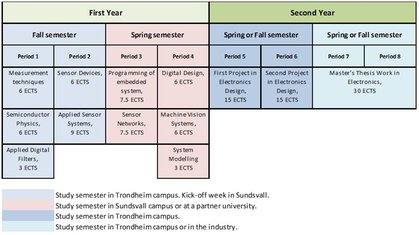
The program covers methods and tools for modelling and design of components, circuits, and systems. It gives a theoretical base covering a wide field of electronics design from semiconductor physics to design of embedded systems. The program integrates the different fields in order to give a good understanding of possibilities and limitations of the different technologies.
These embedded systems consist of different technologies for data processing, communication, sensing, analogue and digital processing. They find application in different fields like measurement technology, power generation, instrumentation and automation.
The International Master’s program in Electronic Systems and Instrumentation aims to provide broad knowledge in the different technologies which make up an embedded sensor system. In the second year individual projects provide you with specialization and in-depth knowledge in a specific field. The projects are carried out in close cooperation with research groups at the department. The courses of the second year are generally project oriented, and some of these projects will be supervised by development engineers from the instrumentation industry (NCEI).
How the study is organized
Semesters 1 includes a one-week kick-off at MiUn, campus Sundsvall. The rest of semester 1, as well as semester 3 and 4, youu will study at HiST in Trondheim.
You will stay at MiUn, campus Sundsvall for the whole semester 2. Alternatively, during semester 2, you will also have the opportunity to study abrosd and get deeper knowledge within the area of automation, at a partner university in France. There are also other possibilities for exchange studies within Europe. In which case the courses offered during semester 2 will differ from those shown below in the programme curriculum.
Your project assignments (semester 4) originate from problems identified by our industrial partners or collaborating research partners.
Entry requirements
Degree of Bachelor, Degree of Bachelor of Science in Engineering (at least 180 Credits), or equivalent, in Electronics Engineering/Electronics, Computer Engineering, Physics or Mathematics, with at least 22.5 Credits (22.5 ECTS) in Mathematics/Applied Mathematics and at least 15 Credits (15 ECTS) in Electronics Engineering.
Proven language proficiency in English.



Høgskolen i Sør-Trøndelag - HiST
Pb 2320. 7004 Trondheim
Telephone: 73 55 90 00
Fax: 73 55 90 51
E-mail: postmottak@hist.no
Kunnskapen du trenger


