|
Transcriptional activation of the cAMP response element-binding protein CREB
Project leader(s)
Ugo Moens
Co-workers / Project staff
Mona Johannessen, Marit Pedersen Delghandi, Marte Dragset, Eric Bendiksen, Synnøve Magnussen, Marijke Van Ghelue
Main Objects:
We want to study the mechanism for transcriptional activation of CREB and to identify the different signalling pathways that converge to CREB
Project outline
The cAMP response element-binding protein (CREB) is a member of the closely related CREB/CREM/ATF family of transcription factors and was originally shown to bind a cAMP-responsive element with consensus motif 5´-TGACGTCA-3´ in the transcription regulatory regions of many cAMP-regulated genes. CREB and most other members of this family possess two major distinct transcription activation domains, a glutamine-rich constitutive activation domain (Q2) and a kinase-inducible transactivation domain (KID). The Q2 domain can interact with the general transcription factor TAF4, and this association is necessary and sufficient for the recruitment of the RNA polymerase II transcription complex. The KID domain acts in a concerted manner with the Q2 domain in CREB-mediated transcription. Phosphorylation of serine-133 (Ser-133) in the KID promotes the recruitment of the coactivator paralogues CBP (CREB-binding protein) and p300. CBP mediates interaction with RNA polymerase II through RNA helicase A. The intrinsic histone acetyltransferase activities and the bridging properties with RNA polymerase II via RNA helicase A of the coactivators CBP/p300 contribute to the augmented CREB-mediated transcription (Figure 1). Although phosphorylation of Ser-133 is crucial for CREB-mediated transcription, it is not sufficient. Several stimuli can induce phosphorylation of CREB at Ser-133 with comparable kinetics and stoichiometry as cAMP agonists, yet fail to activate CREB. Our research is directed against understanding the mechanism(s) underlying the ability/inability of a particular stimulus to activation of CREB. Moreover, we investigate the effect of cross-talk between different signalling pathways on CREB-mediated transcription.
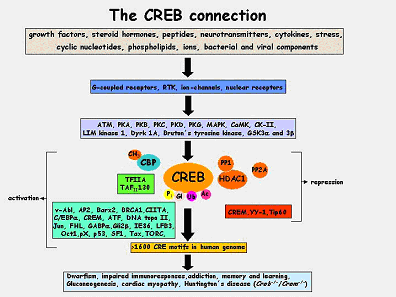 |
| A wide array of different stimuli can trigger the phosphorylation of CREB at Ser-133. Stimulus-induced CREB phosphorylated is mediated by different protein kinases that are constituents of distinct pathways that converge to CREB. Additional post-translational modifications of CREB and protein-protein interactions interfere with CREB-driven transcription. |
Funding
This project is funded by the Norwegian Cancer Society (Kreftforeningen), the Norwegian research Council (NFR), and the Olav and Erna Aakre Cancer Foundation.
Publications
Johannessen, M. and Moens, U. (2007). Multisite phosphorylation of the cAMP response element-binding protein (CREB) by a diversity of protein kinases. Frontiers in Bioscience, 12:1814-1832.
Johannessen, M. and Moens, U. (2005). Transcription of Genes in Response to Activated cAMP-Protein Kinase A Signaling Pathway: There is More to it Than CREB. Trends in Cellular Signalling (Ed. Caplin,DE). pp. 41-78. Nova Publisher; ISBN:1-59454-633-9
Pedersen Delghandi, M., Johannessen, M., and Moens, U. (2005) The cAMP signalling pathway activates CREB through PKA, p38 and MSK1 in NIH3T3 cells. Cell Signall., 17:1343-1351.
Johannessen, M., Pedersen Delghandi, M., and Moens, U. (2004). What turns CREB on? Cell Signall.; 16:1211-1227.
Johannessen, M., Pedersen Delghandi, M., Seternes, O.M., Johansen, B., and Moens, U. (2004). Synergistic activation of CREB-mediated transcription by forskolin and phorbol ester requires PKC and depends on the glutamine-rich Q2 transactivation domain. Cell Signall. 16:1187-1899.
Johannessen, M., Olsen, P.A., Johansen, B., Seternes, O.M., and Moens, U. (2003). Activation of the coactivator four-and-a-half-LIM-only protein FHL2 and the c-fos promoter through inhibition of protein phosphatase 2A. Biochem. Pharmacol. 65: 1317-1328.
Seternes O.M, Johansen B, Moens U. (1999). A dominant role for the Raf-MEK pathway in forskolin, 12-O-tetradecanoyl-phorbol acetate, and platelet-derived growth factor-induced CREB (cAMP-responsive element-binding protein) activation, uncoupled from serine 133 phosphorylation in NIH 3T3 cells. Mol Endocrinol. 13:1071-83.
Seternes O.M, Sorensen R, Johansen B, Moens U. (1999). Activation of protein kinase A by dibutyryl cAMP treatment of NIH 3T3 cells inhibits proliferation but fails to induce Ser-133 phosphorylation and transcriptional activation of CREB. Cell Signall. 11:211-9.
|


