|
Studies on the function of the mitogen-activated protein kinase MK5/PRAK
Project leader(s)
Ugo Moens
Co-workers / Project staff
Theresa Mikalsen, Nancy Gerits, Mona Johannessen, Sergiy Kostenko, Alexey Shiryaev
Main Objects:
This project aims at defining the biological role of the mitogen-activated protein kinase activated protein kinase MAPKAPK-5 (MK5 or PRAK).
Project outline
Mitogen-activated protein kinases (MAPK) are components of signalling pathways involved in the regulation of different cellular processes, including gene expression, proliferation, differentiation, motility, and apoptosis. MAPK are activated by a wide variety of stimuli, and the activity of MAPK is mainly regulated by specific phosphorylation/dephosphorylation events. The MAPK family is organized in modules consisting of at least three protein kinases, a MAPK kinase kinase (MAPKKK), a MAPK kinase (MAPKK) and the MAPK (figure 1). The MAPKK is a dual specific kinase that phosphorylates threonine and tyrosine in the signature sequence Thr-X-Tyr (TXY) in MAPK. The mammalian MAPK family consists of five distinct subgroups (Figure 1): extracellular signal-regulated kinases (ERKs) 1 and 2 (ERK1/2), c-Jun amino-terminal kinases (JNKs) 1, 2, and 3, p38 isoforms a, b, g, and d, ERKs 3 and 4, and ERK5, where the different MAPKs varies in the signature sequence. The ERK signature (ERK1/2, ERK5, and ERK7) consists of a TEY (Thr-Glu-Tyr) motif, the JNK signature consists of a TPY (Thr-Pro-Tyr) motif, and the p38 family contains a TGY (Thr-Gly-Tyr) motif. Activated MAPKinases may phosphorylate different substrates or other kinases, e.g MAPKAPkinases. Our group is especially interested in the MAPKAPKkinase 5 (MK5/PRAK). We, in collaboration with Drs. Stephen Keyse and Ole Morten Seternes, have previously studied the regulation of the subcellular localization of MK5 and identified ERK3 as an interaction partner. Our research now focuses on exploring a biological role of MK5 in mammalians
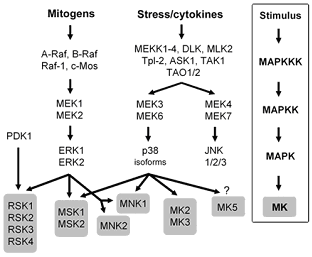 |
| The mitogen-activating protein kinase signalling pathways consist of a module built up of three protein kinases that subsequently phosphorylate and activate each other. The MAP kinase can either directly phosphorylate non-kinase substrates, or they can activate yet another protein kinase (MK), which then in turn phosphorylates substrates. (Figure source: Roux PP, Blenis J. 2004. Microbiol Mol Biol Rev. 68:320-44.) |
Funding
This project is funded by the Norwegian Cancer Society (Kreftforeningen), the Research Council of Norway
(NFR), and the Olav and Erna Aakre Cancer Foundation.
Publications
Gerits, G., Kostenko, S. and Moens, U. In vivo functions of mitogen-activated protein kinases: conclusions from knock-in and knock-out mice. Transgene Research. In press.
Mikalsen, T., Gerits, N., and Moens, U. Inhibitors of signal transduction protein kinases as targets for cancer therapy. Biotechnology Annual Review (2006) 12:153-223.
Mikalsen, T., Johannessen, M., and Moens, U. Sequence- and position-dependent tagging protects extracellular-regulated kinase 3 protein from 26S proteasome-mediated degradation. Int. J. Biochem. Cell. Biol.; (2005) 37:2513-2520.
Seternes, O.M., Mikalsen, T., Johansen, B., Michaelsen, E., Armstrong, C.G., Morrice, N.A., Moens, U., and Keyse, S.M. (2004). Activation of MK5/PRAK by the atypical MAP kinase ERK3 defines a novel signal transduction pathway. EMBO J. 23:4780-91. [Corrected in EMBO J. (2005) 24:873-4].
Seternes, O.M., Johansen, B., Hegge, B., Johannessen, B., Keyse, S.M., and Moens, U. (2002). Both binding and activation of p38 mitogen-activated protein kinase (MAPK) play essential roles in regulation of the nucleocytoplasmic distribution of MAPK-activated protein kinase 5 by cellular stress. Mol. Cell. Biol. 22: 6931-6945.
|


